Printable Worksheets for Kids Ages 2–7
BrainRotU builds printable worksheets across 49 activity types — counting, matching, tracing, patterns, early reading, and more — for kids ages 2 to 7. Every sheet is generated fresh for one child: tuned to their age and printed on the theme they love, from dinosaurs to outer space. Browse the library below, then print your child's own — the first three are free.
Browse by skill
Counting
Counting worksheets ask a child to count a group of objects and match it to a number, building one-to-one correspondence and number recognition — the foundation of early math.
Patterns
Pattern worksheets show a repeating sequence and ask the child what comes next, building the predictive, logical thinking that underpins both math and reading.
Comparisons
Comparison worksheets ask a child to judge more or less, bigger or smaller, same or different — the quantity and attribute reasoning behind early number sense.
Sorting
Sorting worksheets ask a child to group objects by a shared attribute like color, kind, or size, building the categorization skills at the root of organized thinking.
Tracing
Tracing worksheets guide a child's pencil along paths, shapes, letters, and numbers, building the fine-motor control and hand strength needed for writing.
Matching
Matching worksheets ask a child to find the pairs — identical pictures, shadows, or quantities — building visual discrimination and focused attention.
Observation
Observation worksheets ask a child to look closely: spot the difference, find what's hidden, notice what doesn't fit — building visual attention to detail.
Classifying
Classifying worksheets ask a child to decide which item doesn't belong in a group, building the category reasoning behind 'these go together, that one doesn't.'
Sequencing
Sequencing worksheets ask a child to put events in order — first, next, last — building the temporal reasoning behind storytelling and step-by-step thinking.
Goes Together
'Goes together' worksheets ask a child to pair items that belong with each other, like a sock and a shoe, building associative reasoning about how the world connects.
Sounds & Syllables
Sounds and syllables worksheets ask a child to hear the beats and beginning sounds in words, building the phonological awareness that precedes reading.
Browse by theme
Your child's interests pick the theme. These are real sample sheets we generated on each one.
Browse by readiness skill
Every worksheet practices specific school-readiness skills, mapped to the frameworks kindergarten teachers use.
Fine Motor
Math
Literacy
Thinking & Focus
World Knowledge
All worksheets
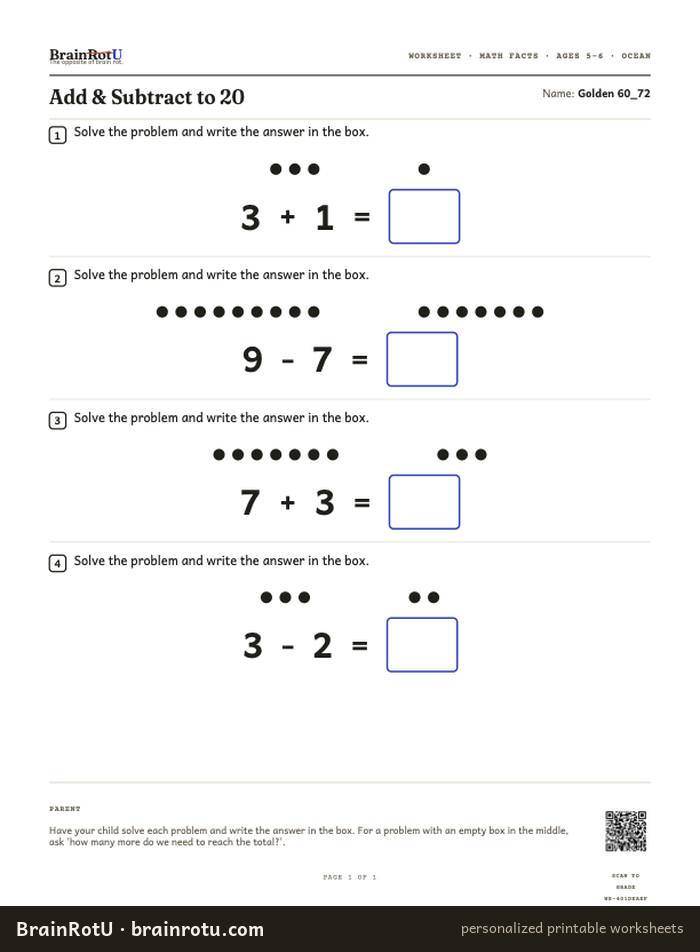
Add & Subtract to 20
BrainRotU turns grade-1 addition and subtraction facts into a themed equation sheet — the child solves each problem and WRITES the answer, with picture support for Kindergarten and numeral-only missing-addend reasoning for first grade (CCSS 1.OA).
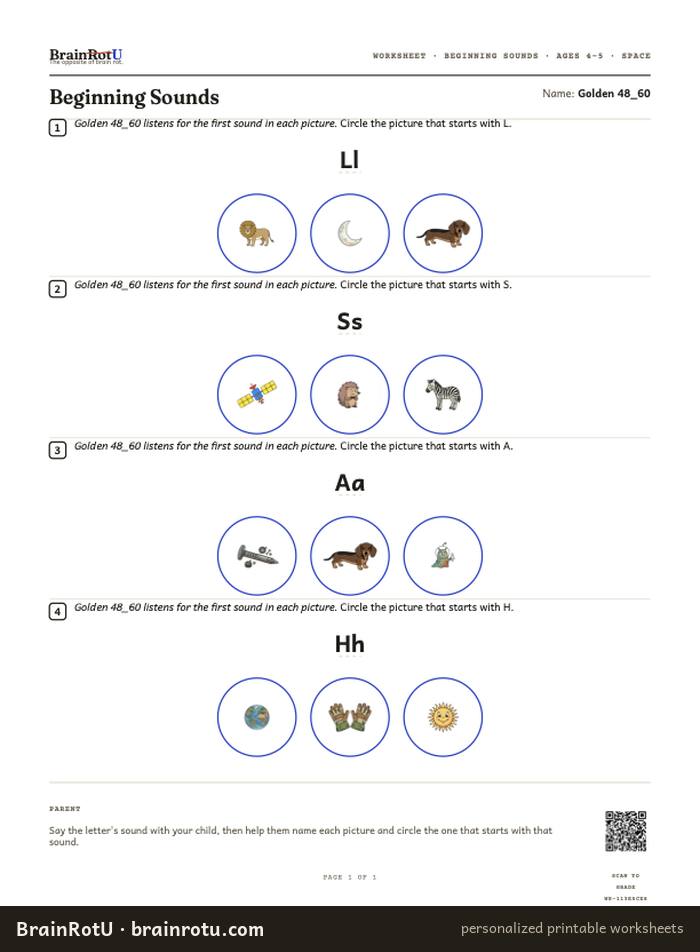
Beginning Sounds
BrainRotU gives the child a printable that shows a letter and a row of pictures and asks them to circle the picture that STARTS with that letter's sound — the first phonemic-awareness win that bridges knowing letters to reading them.
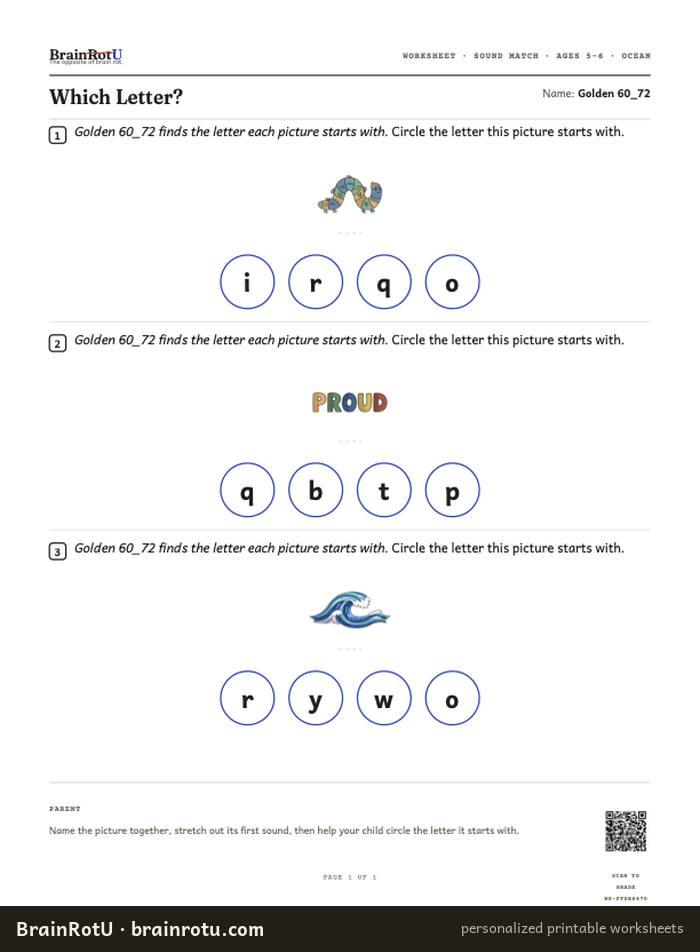
Which Letter?
BrainRotU gives the child a printable that shows a picture and a row of letters and asks them to circle the letter the picture STARTS with — the reverse of beginning sounds, mapping the object's first sound back to its letter.
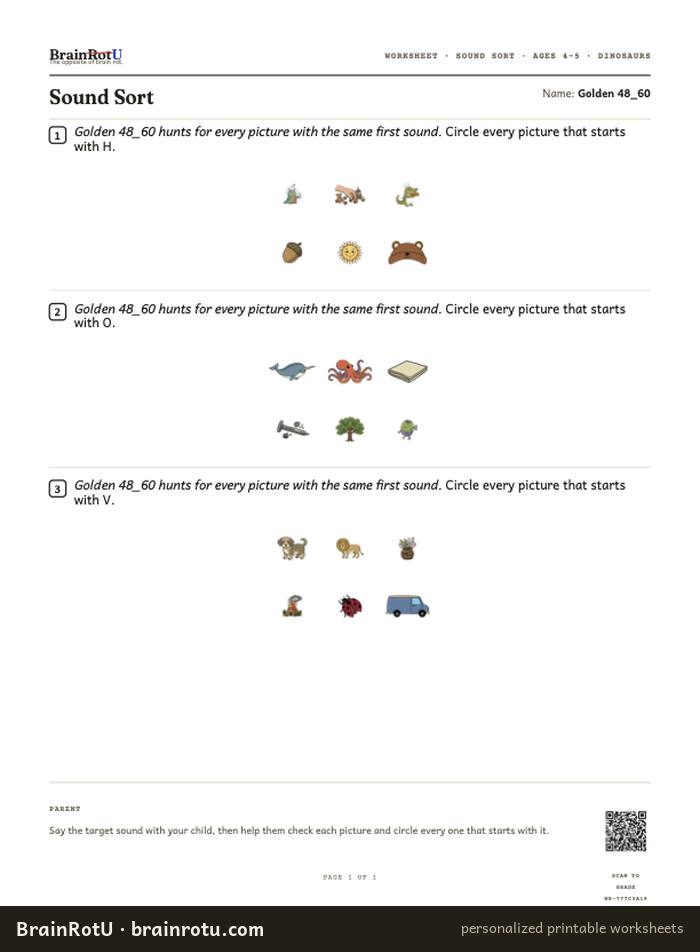
Sound Sort
BrainRotU gives the child a printable grid of pictures and asks them to circle every one that starts with a target sound — a sustained beginning-sound scan that sharpens phonemic awareness beyond a single pick.
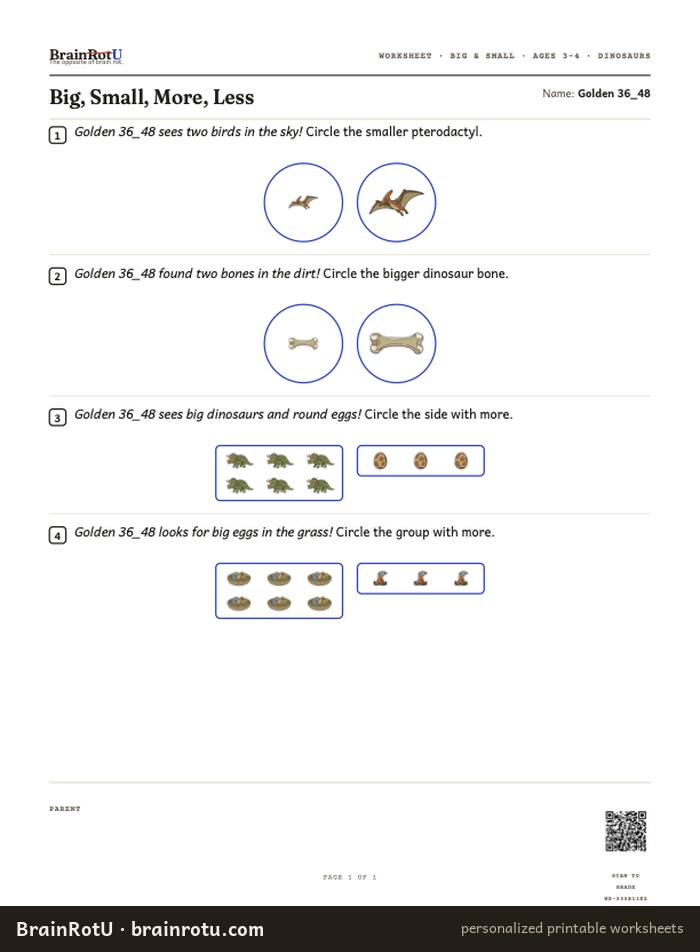
Big, Small, More, Less
BrainRotU gives the child a themed comparison activity that teaches foundational size and quantity ideas in a simple visual way.
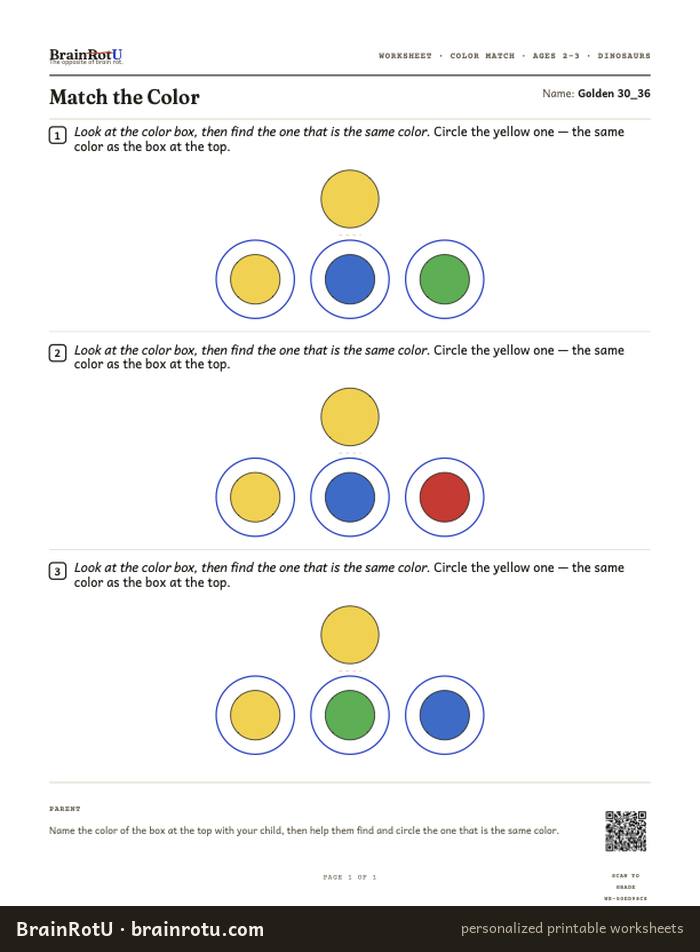
Match the Color
BrainRotU gives the child a printable with a color swatch and a row of colors and asks them to circle the one that is the same — the earliest visual-discrimination win, teachable before counting or reading.
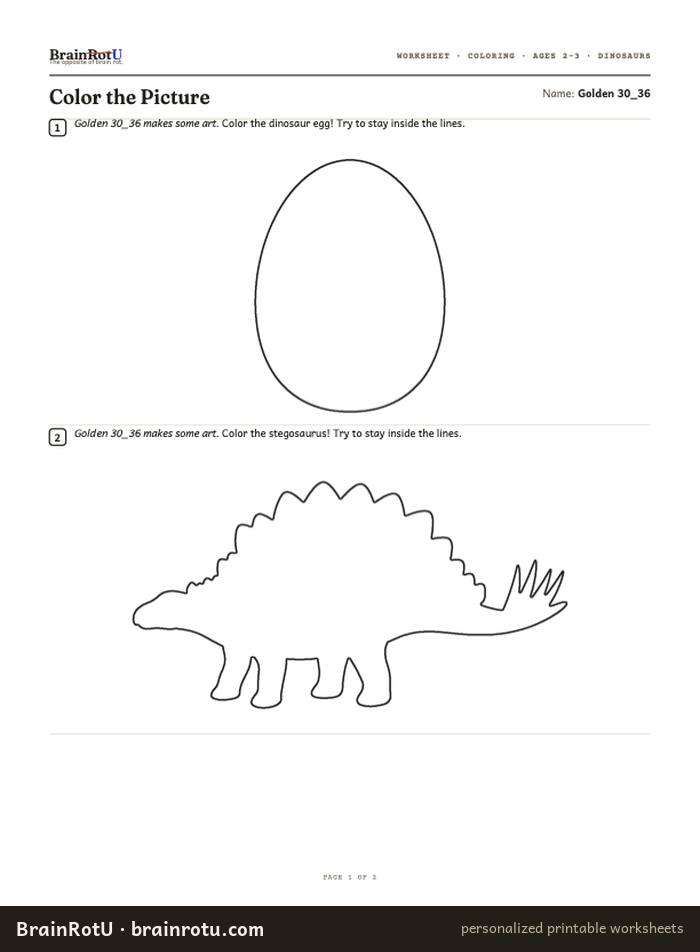
Color the Picture
BrainRotU gives the child a big line drawing of something they love — drawn from their own theme — to color in, building crayon control, hand strength, and stay-inside-the-lines precision from the toddler years up.
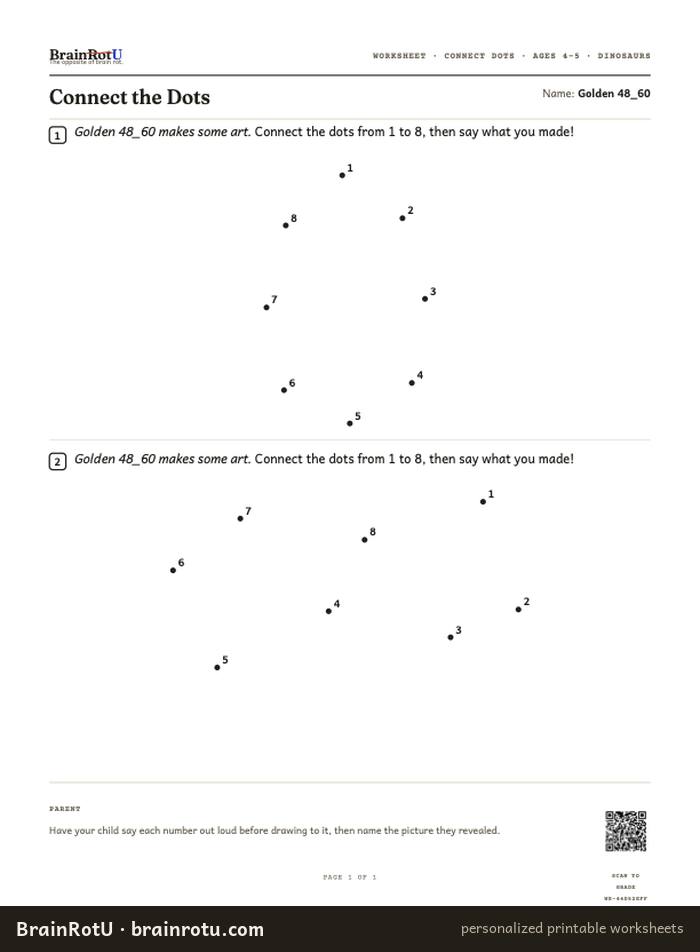
Connect the Dots
BrainRotU turns the child's favorite things into numbered dot-to-dot puzzles — connect the dots in order to reveal the picture, practicing the number sequence and pencil control in one stroke.
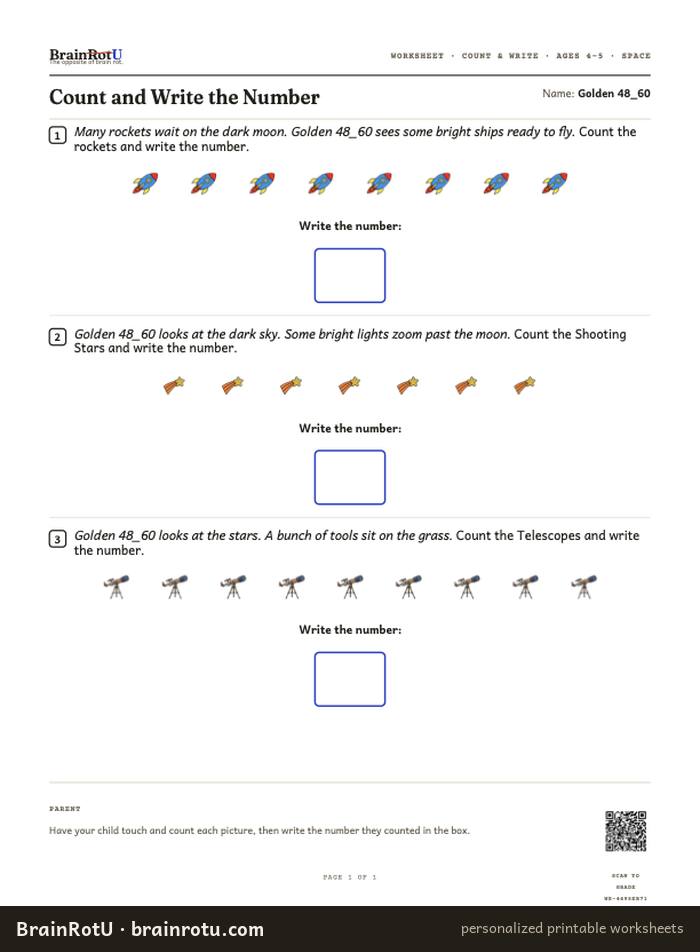
Count and Write the Number
BrainRotU gives the child a themed scene with a set of countable objects and asks them to count and WRITE the matching number — the Kindergarten step beyond counting-and-circling that builds numeral formation and cardinality.
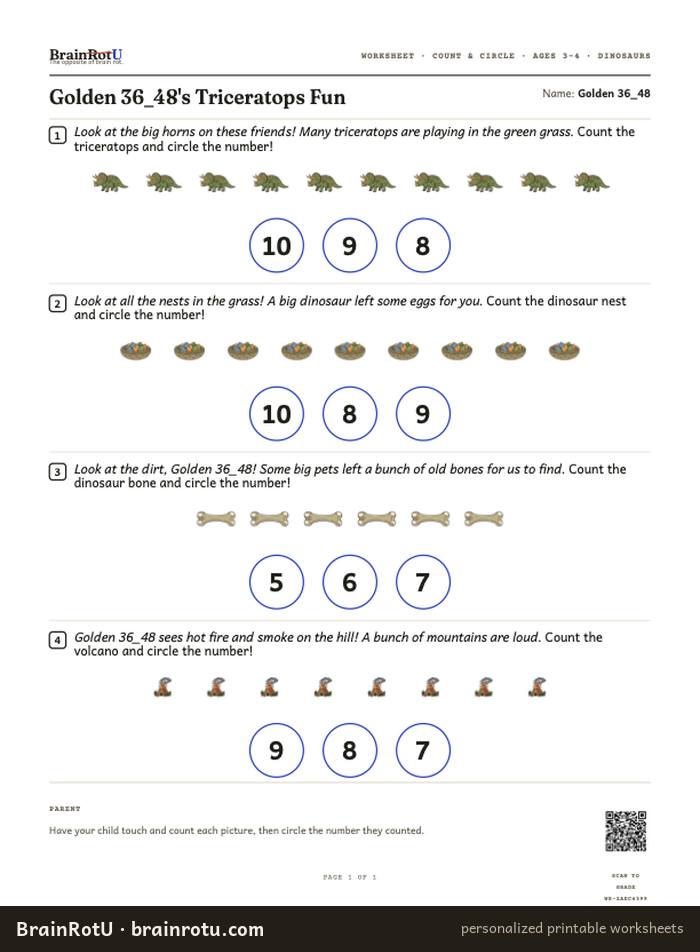
Count and Circle the Correct Number
BrainRotU gives the child a fun themed scene with a small set of countable objects and asks them to choose the correct number in a way that feels playful, not test-like.
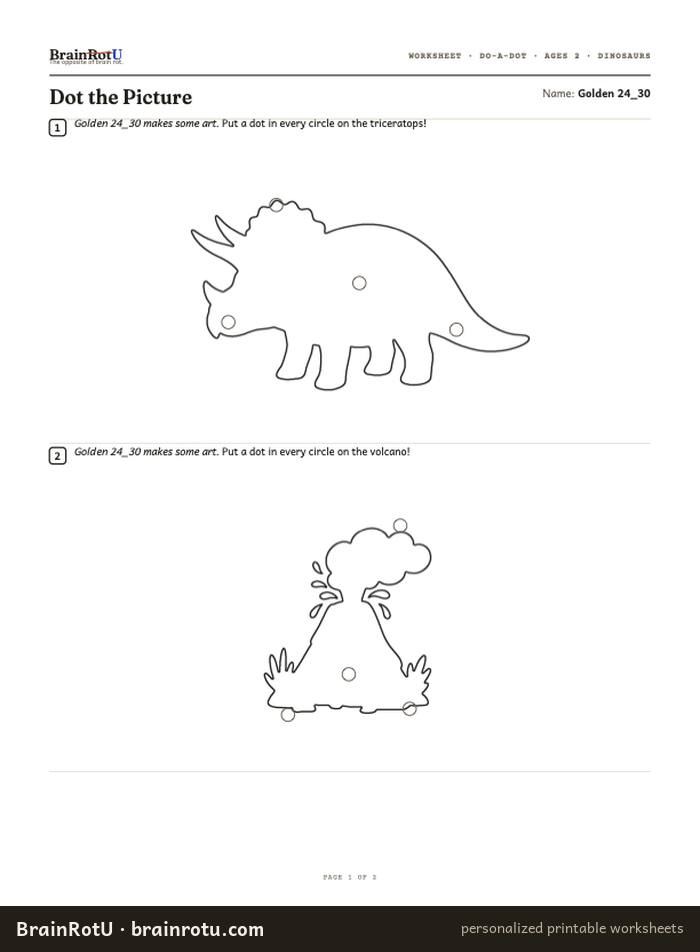
Dot the Picture
BrainRotU gives the child a big themed picture with dab circles to fill using a dot marker, stickers, or a painted fingertip — building hand-eye targeting and one-to-one correspondence the fun, messy way.
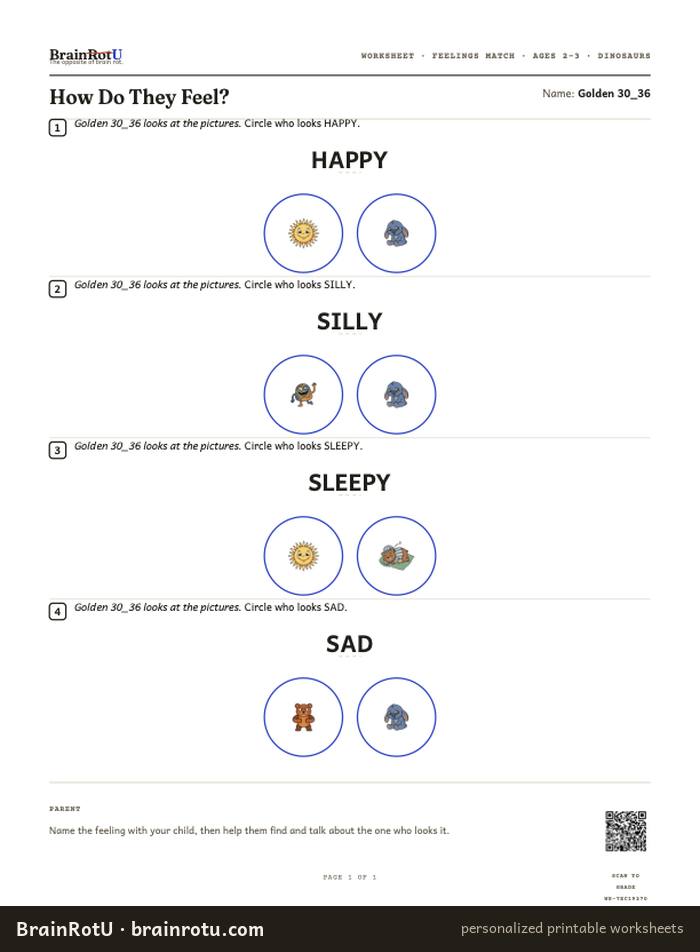
How Do They Feel?
BrainRotU shows the child a row of characters and asks them to circle the one who looks a feeling — happy, sad, scared — building the emotion vocabulary and social-emotional awareness that underpins how children name and manage their feelings.
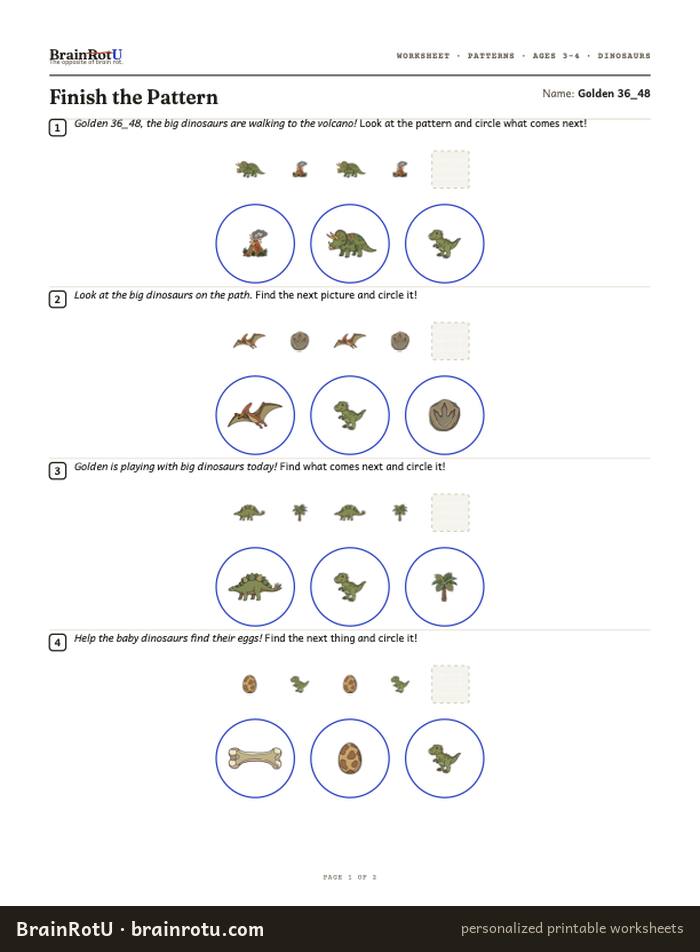
Finish the Pattern
BrainRotU gives the child a themed visual pattern activity that feels clever, fun, and strongly school-ready without becoming too abstract too early.
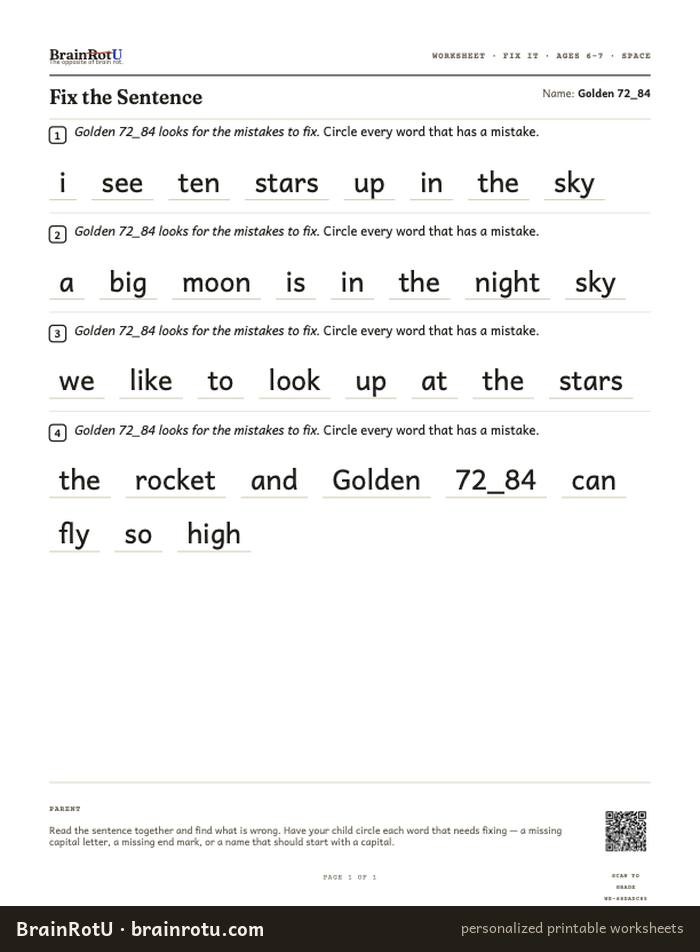
Fix the Sentence
BrainRotU gives the child a themed grade-1 sentence with mistakes hidden in it — a missing capital, a missing end mark, a lowercase name — and asks them to circle every word that needs fixing, building the capitalization and end-punctuation editing skill.
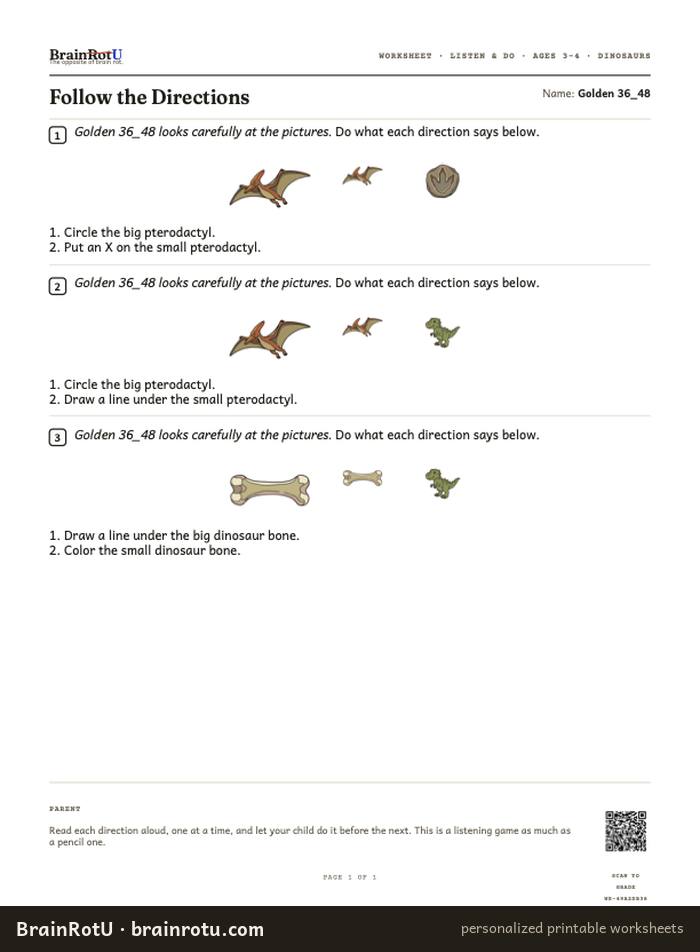
Follow the Directions
BrainRotU gives the child a short list of picture instructions to carry out (circle this, cross out that, underline the other) — the School Zone listening-and-doing staple that builds receptive language, working memory, and multi-step direction-following.
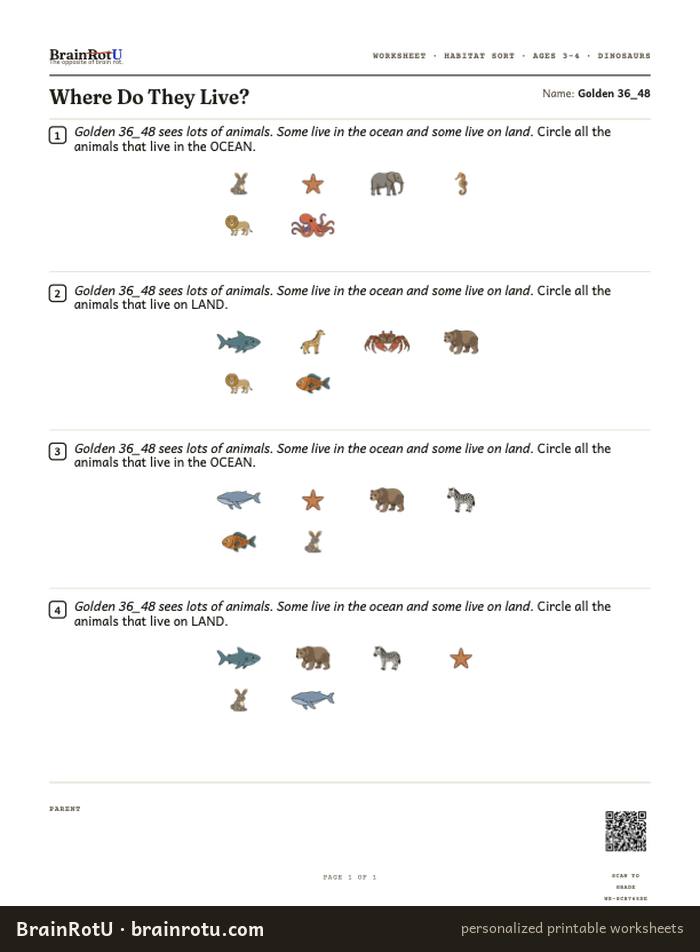
Where Do They Live?
BrainRotU shows the child a mix of animals and asks them to circle the ones that live in a place — the ocean, the land — building the classify-by-a-real-world-property reasoning that underpins science and categories.
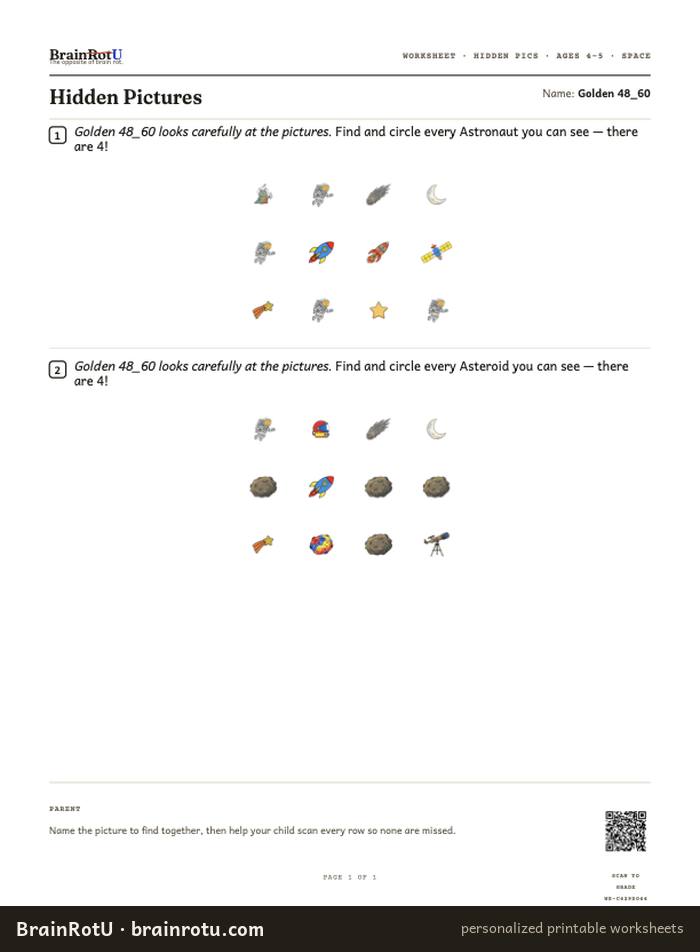
Hidden Pictures
BrainRotU hides several copies of one themed object among a scene of other objects and asks the child to find and circle every one — the Highlights I-spy staple, building visual scanning, discrimination, and focused attention with the child's own favorite theme.
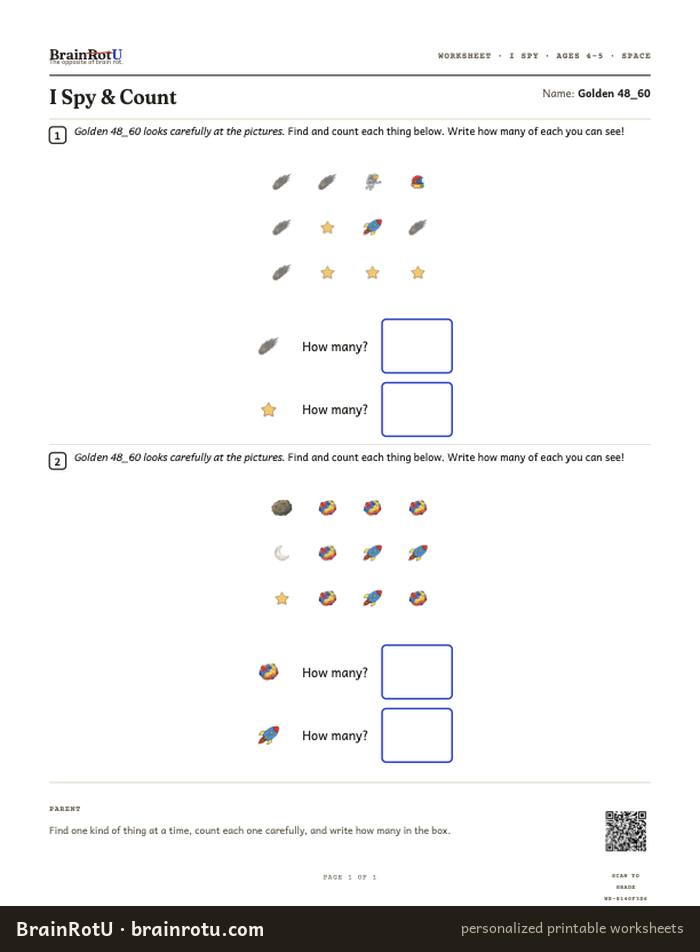
I Spy & Count
BrainRotU fills a scene with the child's favorite theme and asks them to find every copy of each object and write how many — the classic I-spy-and-count page, joining visual scanning, one-to-one counting, cardinality, and numeral writing in one activity.
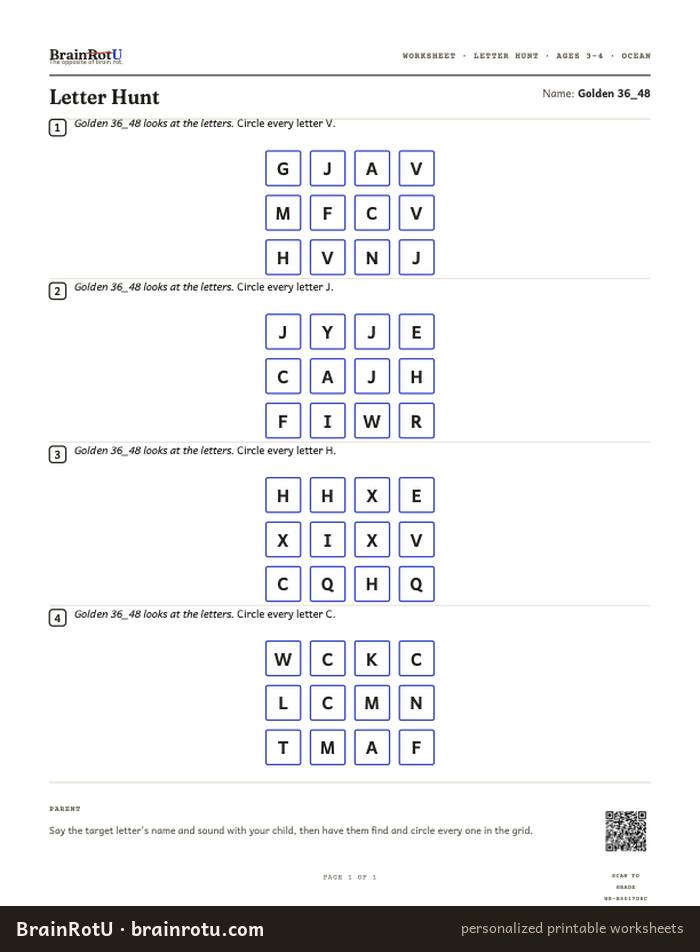
Letter Hunt
BrainRotU gives the child a printable grid of letters and asks them to find and circle every one that matches the target letter — building fast letter recognition and, at the oldest band, b/d/p/q reversal discrimination.
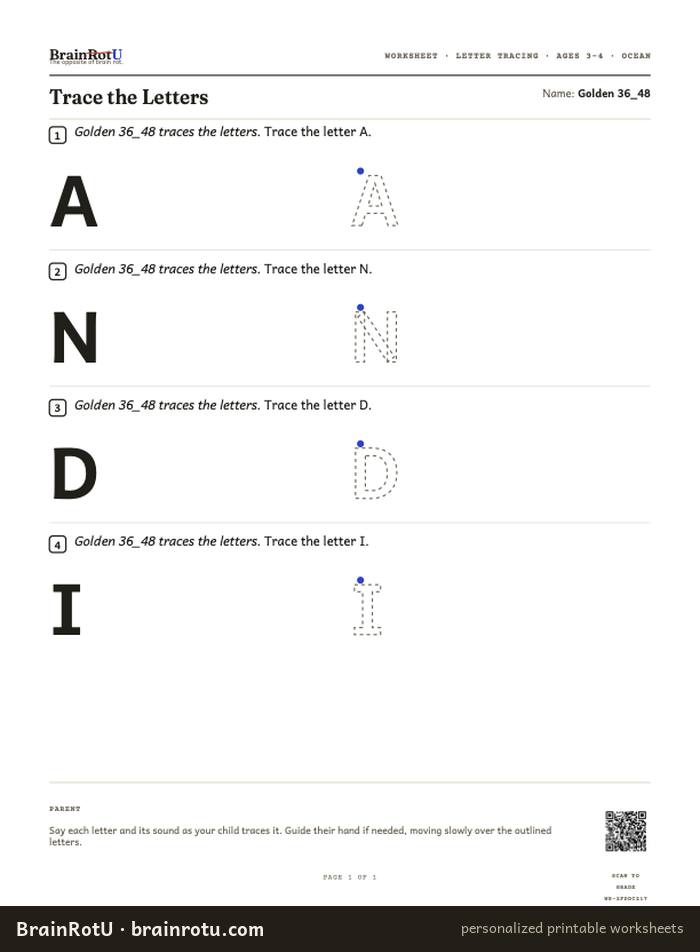
Trace the Letters
BrainRotU gives the child a themed printable where they trace uppercase and lowercase letters — and short words at Kindergarten — building the letter-formation control that precedes independent writing.
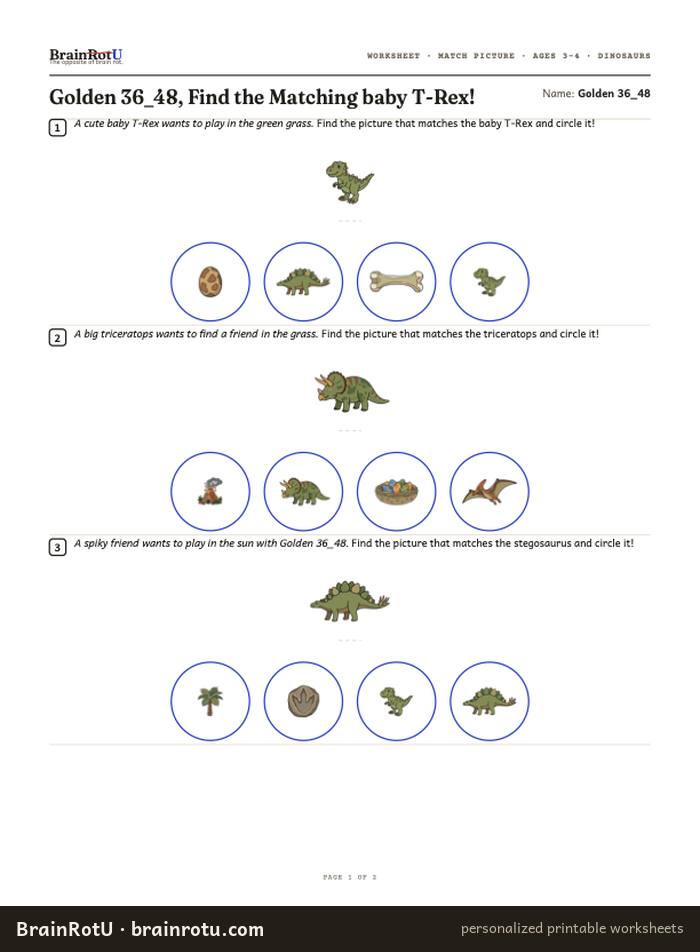
Find and Circle the Matching Picture
BrainRotU gives the child a playful themed visual matching activity that feels intuitive and rewarding, even for younger learners.
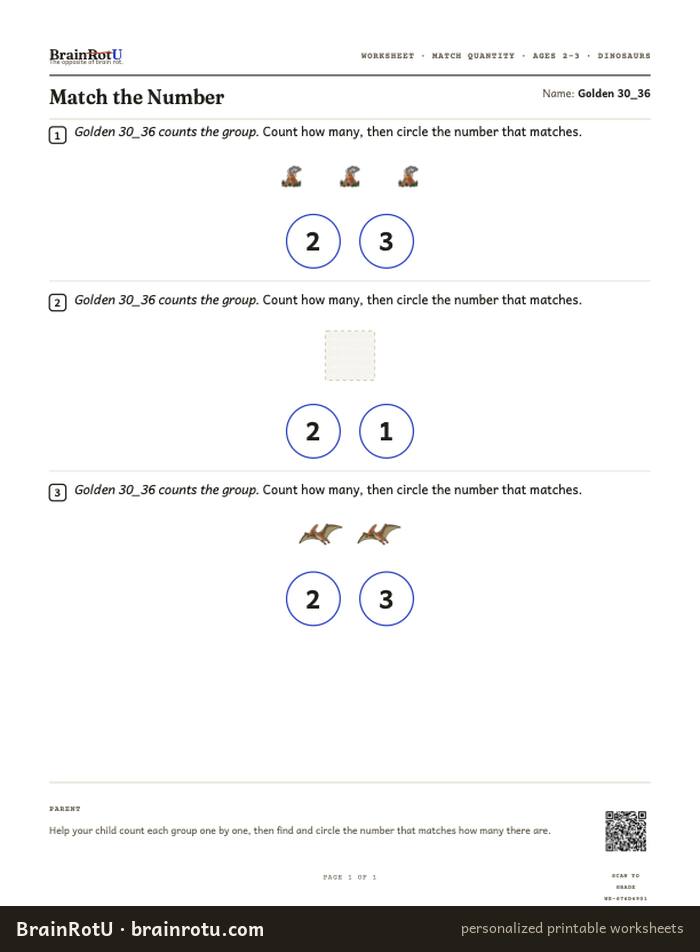
Match the Number
BrainRotU gives the child a group of themed objects to count and a row of big numbers to choose from — circle the number that tells how many. It builds the cardinality-to-symbol link (a set of things has a matching written number) that precedes written arithmetic.
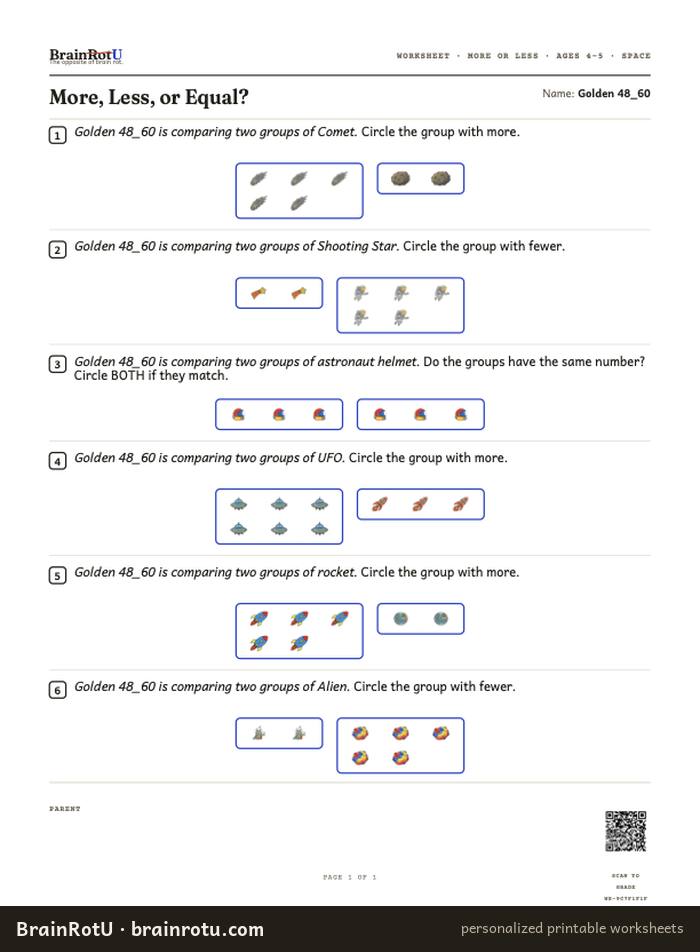
More, Less, or Equal?
BrainRotU gives the child two themed groups to compare, marking which has more, which has fewer, or that the two groups are equal — extending more/less comparison to the all-important idea of 'the same'.
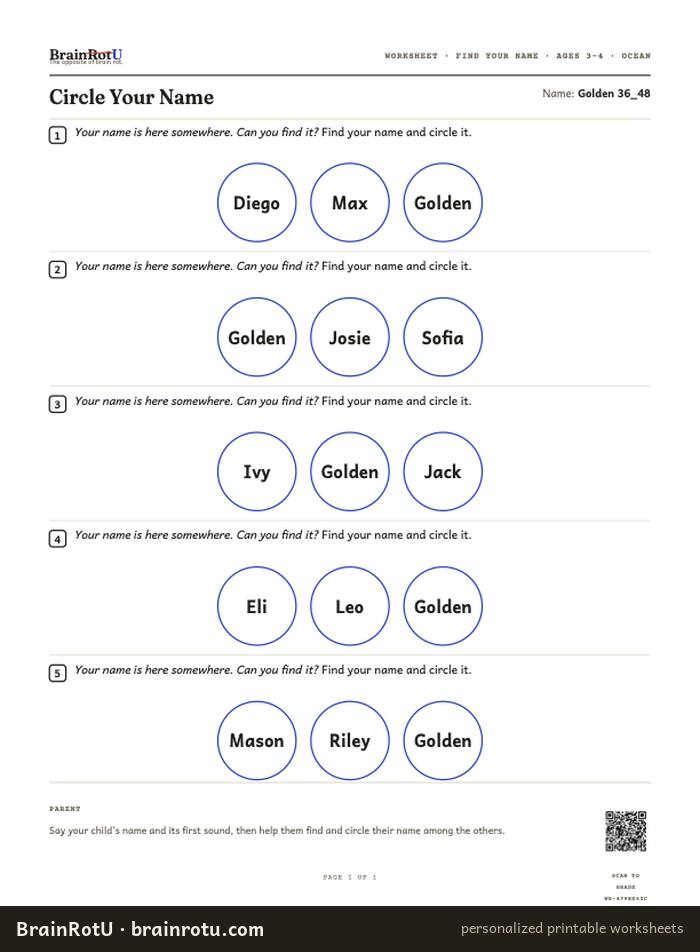
Circle Your Name
BrainRotU gives the child a printable that asks them to find and circle their OWN name among other names — the first print-awareness win, teaching a child to recognize their name as a whole word before they can read.
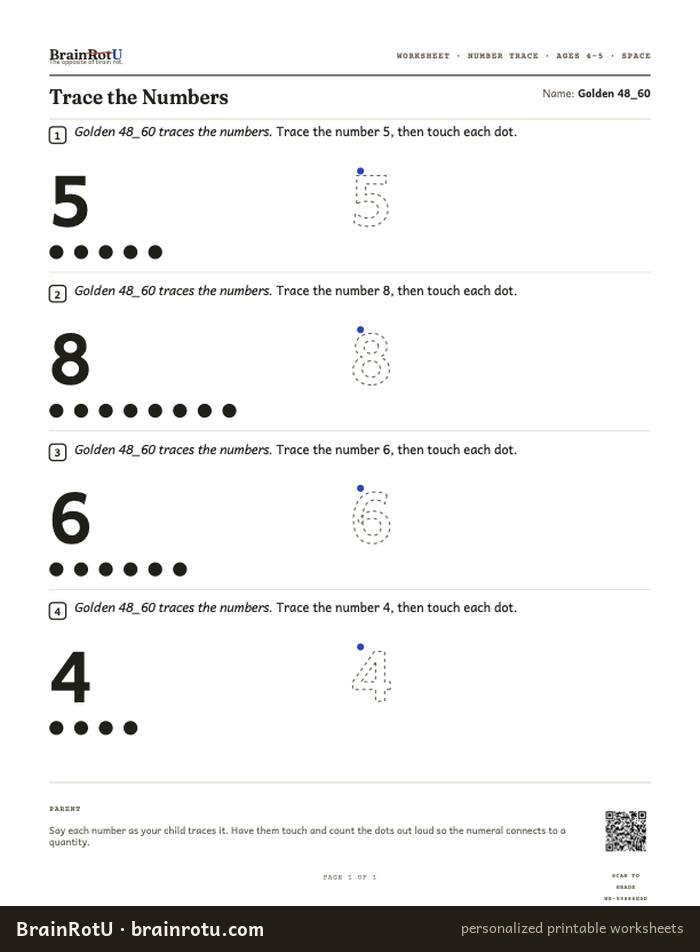
Trace the Numbers
BrainRotU gives the child a themed printable where they trace numerals — pairing a digit with that many objects, and forming teen numbers at Kindergarten — building numeral-writing control alongside counting.
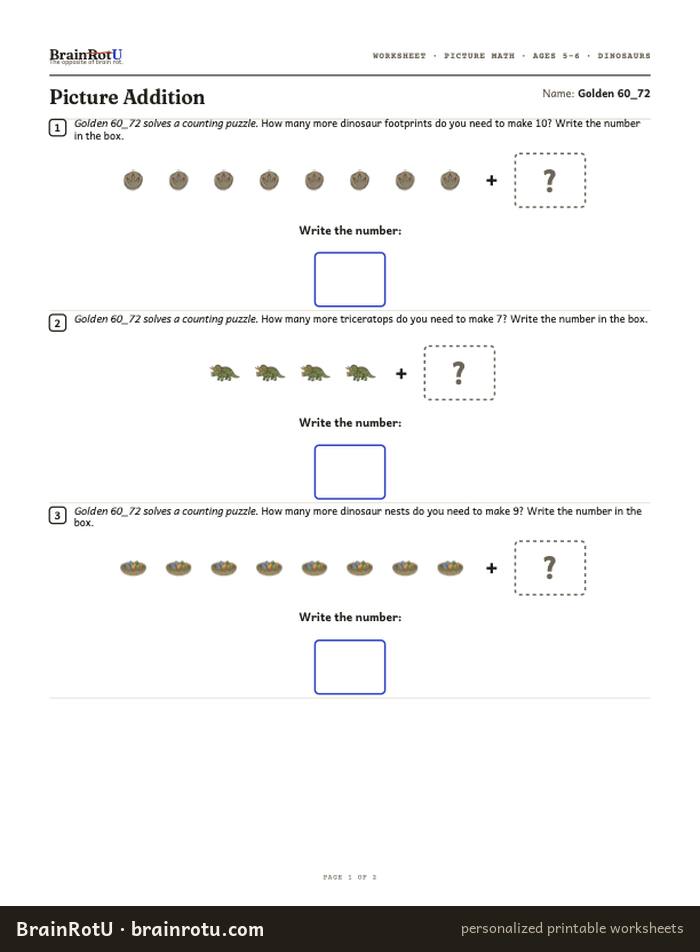
Picture Addition
BrainRotU shows the child two groups of themed objects joined by a plus sign and asks how many there are altogether — building the concrete counting-on foundation for Kindergarten addition with pictures they can actually touch and count.
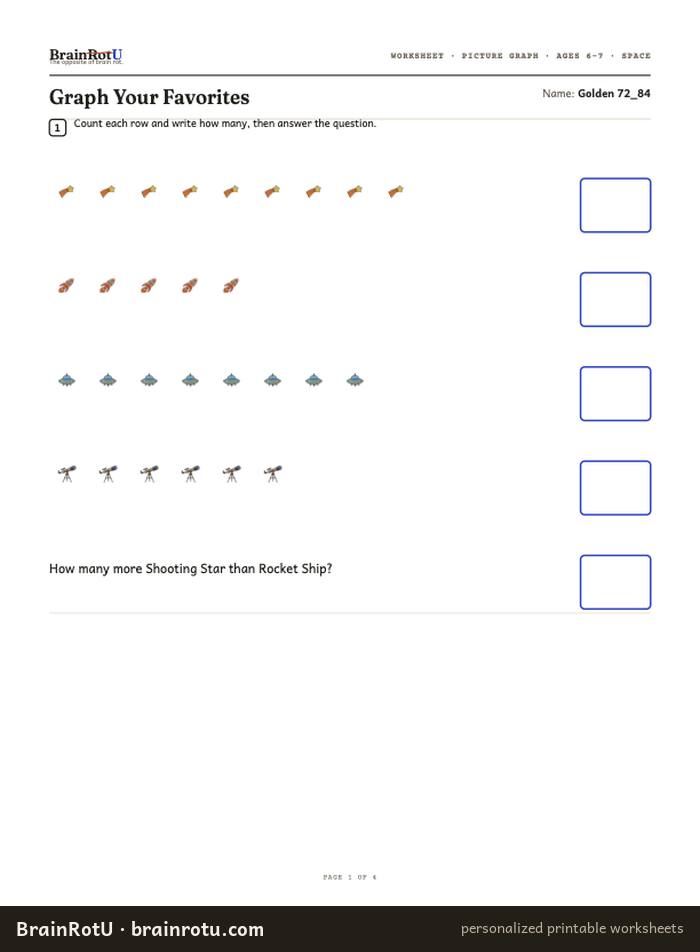
Graph Your Favorites
BrainRotU gives the child a printable picture graph of their favorite themed objects — count how many of each and write the number in the box — building one-to-one counting, cardinality, and the first taste of reading data a Kindergartner-into-grade-1 needs.
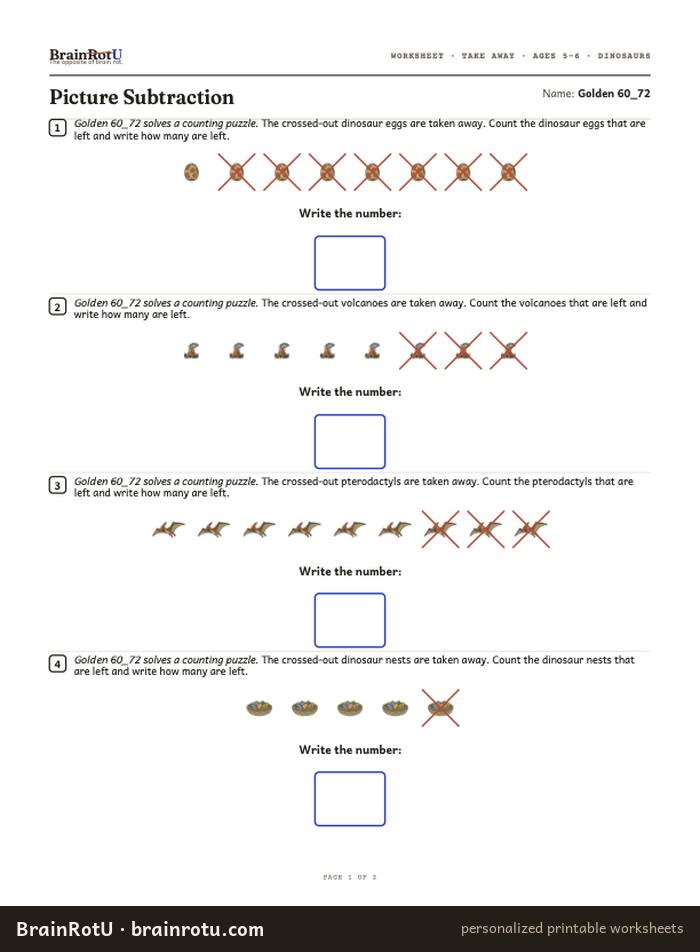
Picture Subtraction
BrainRotU shows the child a group of themed objects with some crossed out and asks how many are left — making take-away subtraction concrete and countable for Kindergarten readiness.
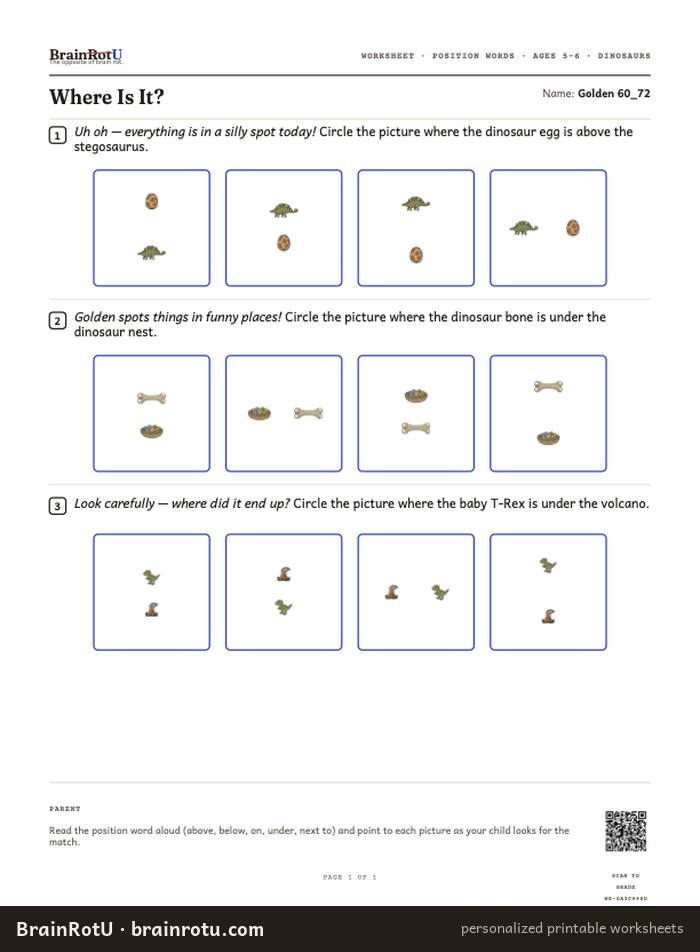
Where Is It?
BrainRotU gives the child a printable that asks them to circle the picture where one thing is above, below, on, under, or next to another — building the spatial-position words that reading, math, and following directions all depend on.
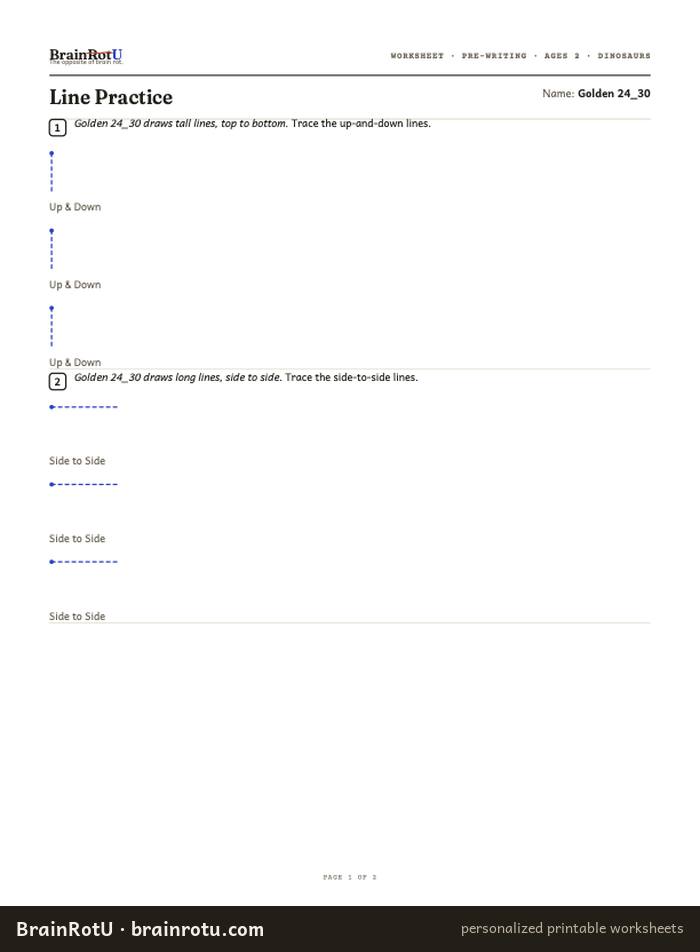
Line & Curve Practice
BrainRotU gives the youngest child a themed printable of big dotted lines and curves to trace — the pre-writing motor practice that comes before letters, shapes, and paths.
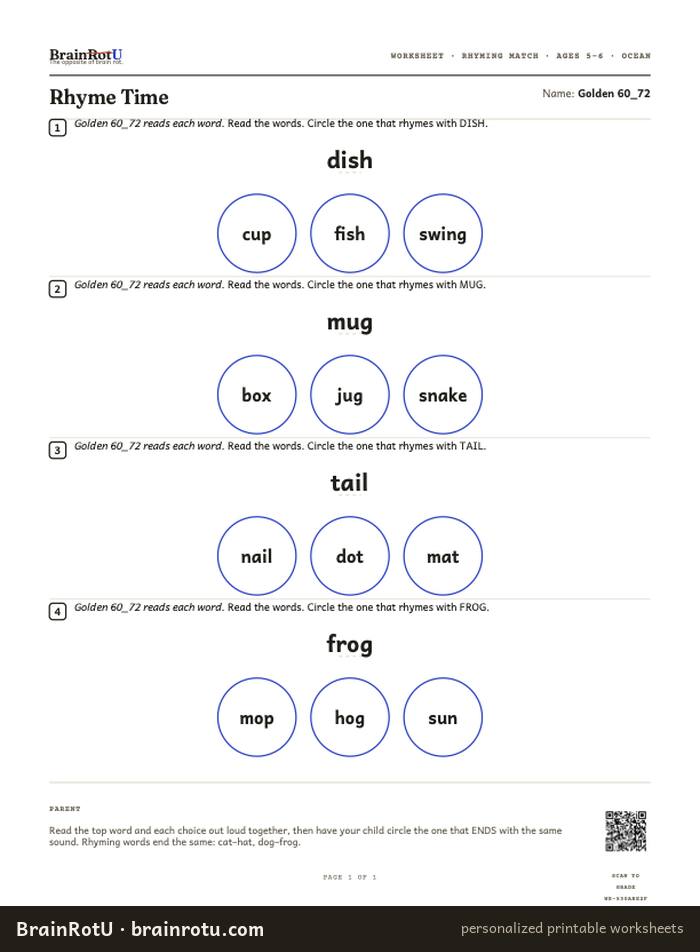
Rhyme Time
BrainRotU shows the child a picture and its word, then a row of picture-words to choose from — circle the one that RHYMES. It builds the rhyme-awareness that is one of the strongest early predictors of reading readiness.
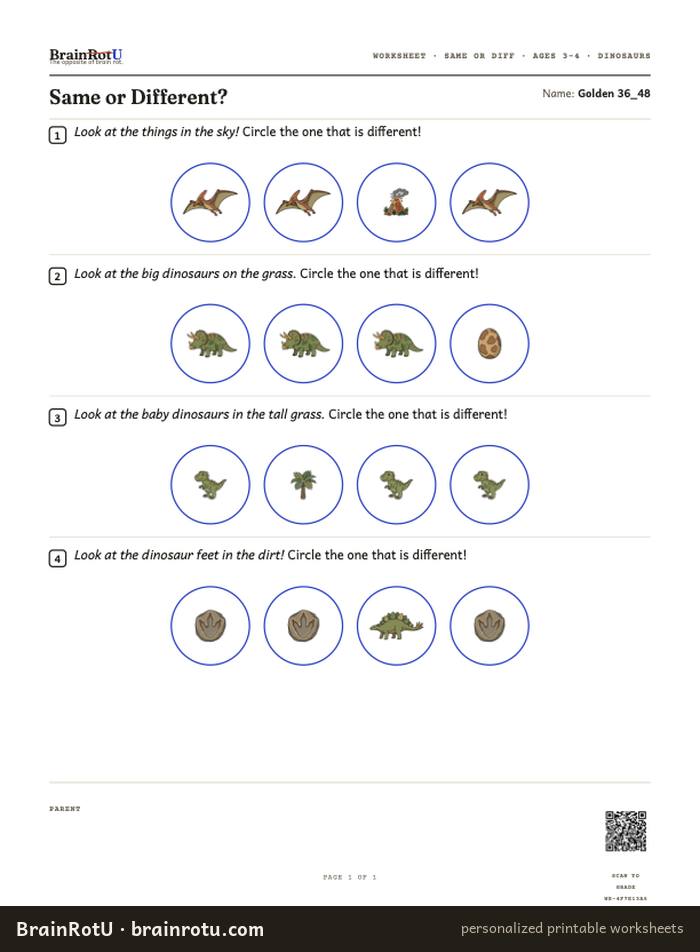
Same or Different?
BrainRotU gives the child a simple themed comparison puzzle that builds observation and reasoning in a playful, age-appropriate way.
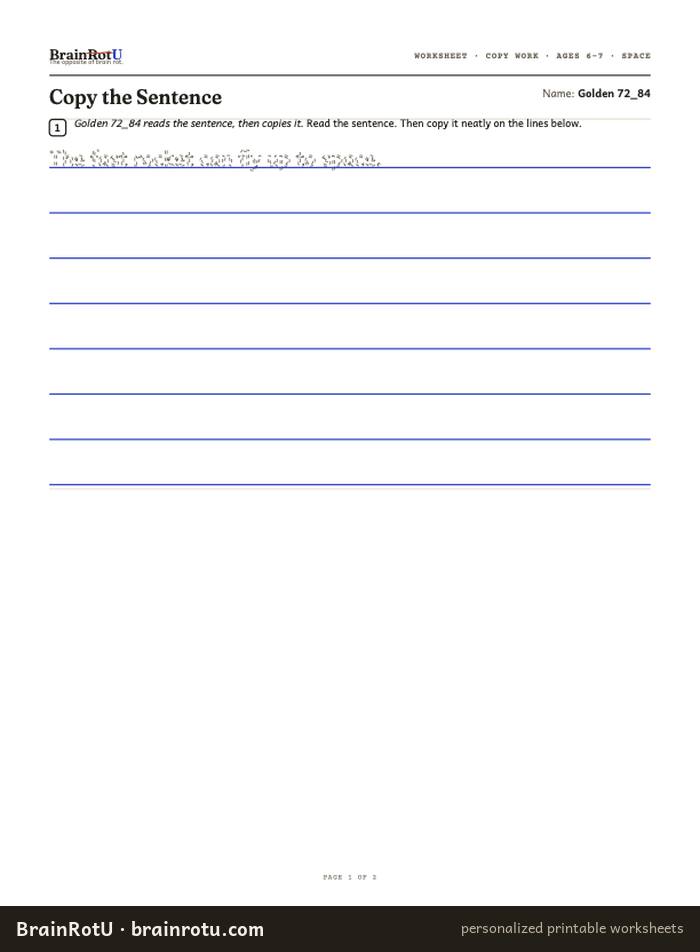
Copy the Sentence
BrainRotU gives the child a printable with a themed model sentence — grade-1 words, a capital letter and end punctuation — and handwriting lines to copy it, building sentence-writing and letter-formation stamina.
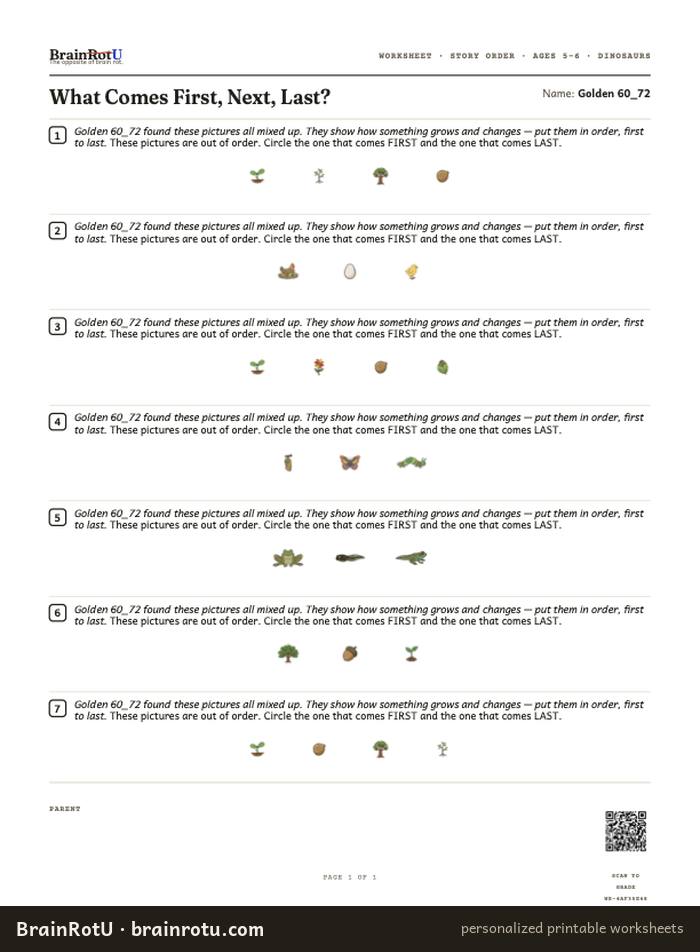
What Comes First, Next, Last?
BrainRotU shows the child a themed mini-story whose pictures are out of order and asks them to circle which one comes first and which comes last — the sequencing-and-ordering reasoning that underpins storytelling, routines, and life cycles.
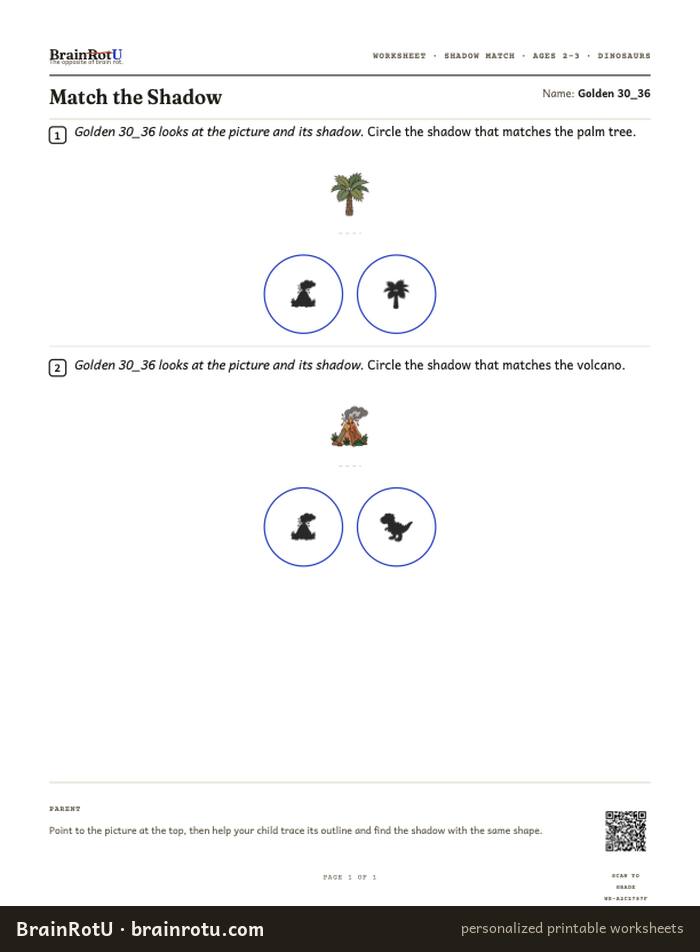
Match the Shadow
BrainRotU shows the child a themed picture and a row of black shadow shapes and asks them to circle the shadow that matches — building object recognition and visual discrimination as they learn a picture and its silhouette are the same thing.
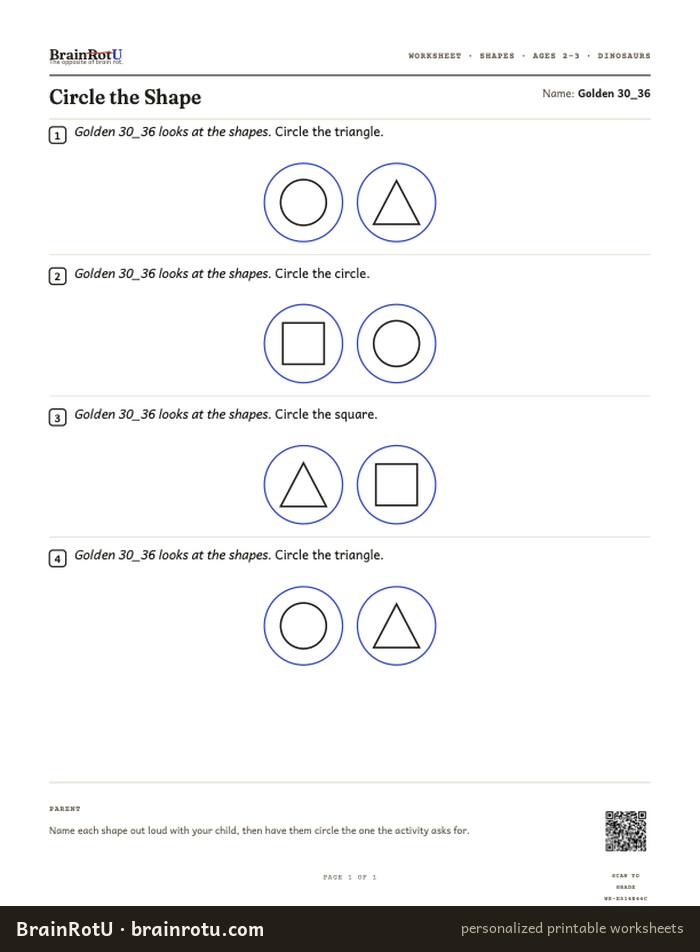
Circle the Shape
BrainRotU gives the child a themed printable that names a shape and asks them to find and circle it among others — building shape vocabulary and visual discrimination.
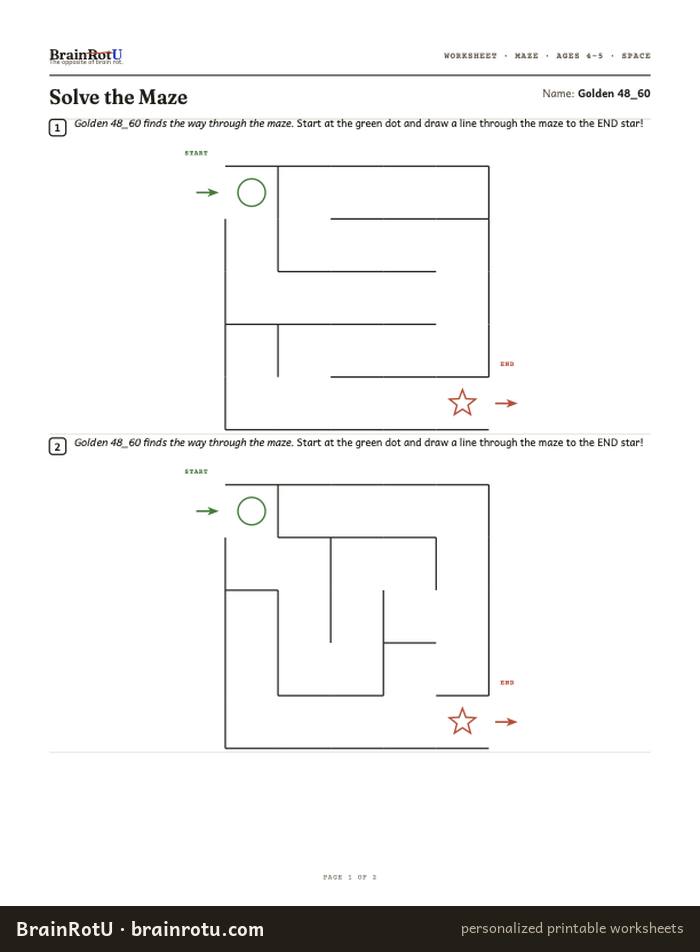
Solve the Maze
BrainRotU gives the child a printable maze — find the path from start to finish — building fine-motor control, visual tracking, and simple planning, with the grid growing from wide toddler corridors to a real Kindergarten navigation puzzle.
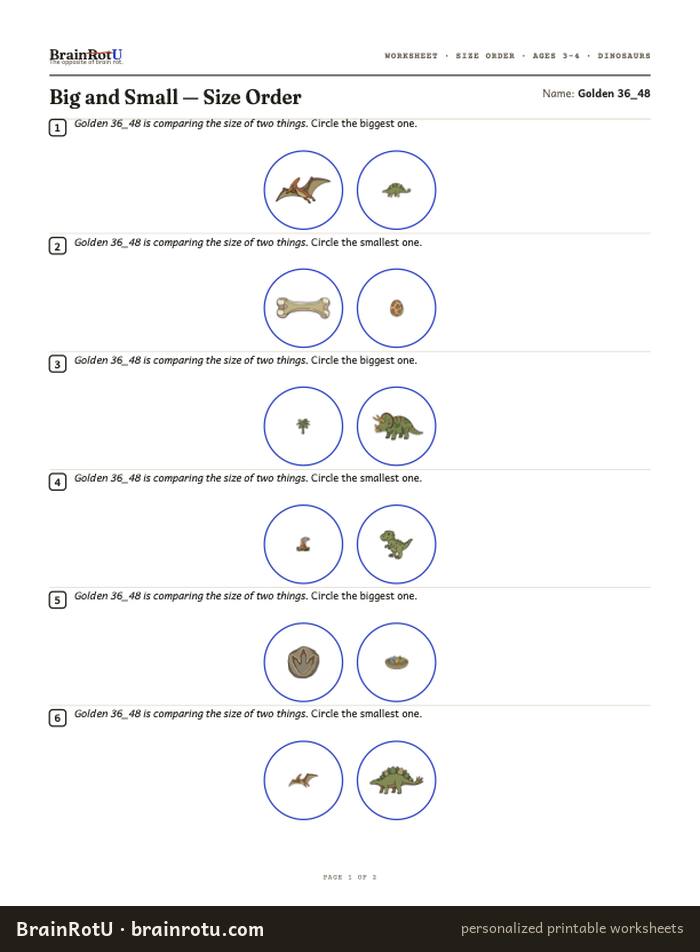
Big and Small — Size Order
BrainRotU shows the child two themed objects of clearly different sizes and asks them to circle the biggest (or the smallest) one — the relative-size and ordering skill that comes after simple big/small matching.
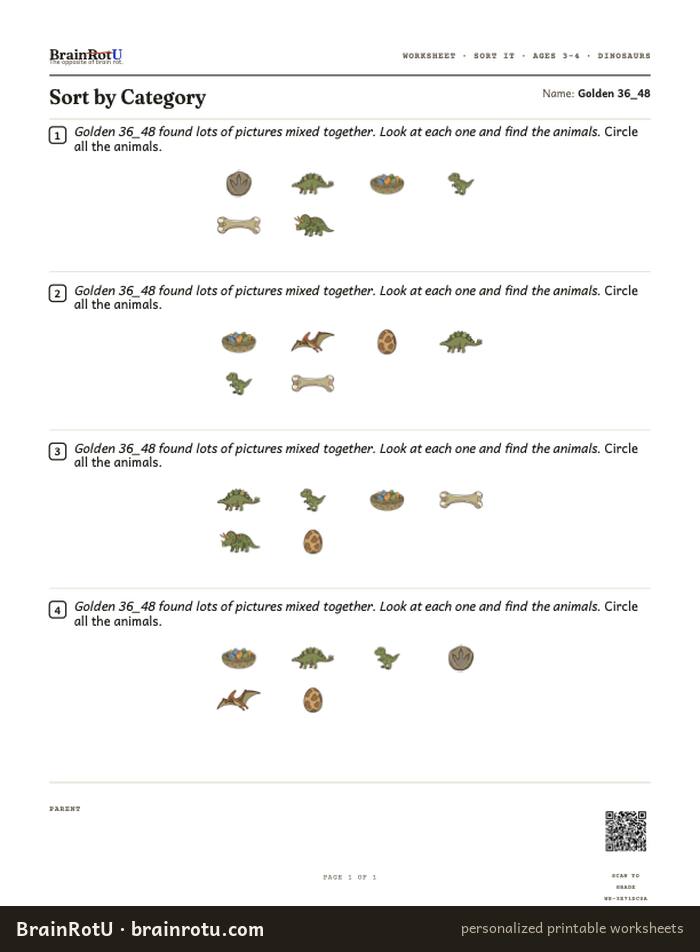
Sort by Category
BrainRotU gives the child a themed sorting activity that feels playful but clearly builds thinking and school-readiness skills.
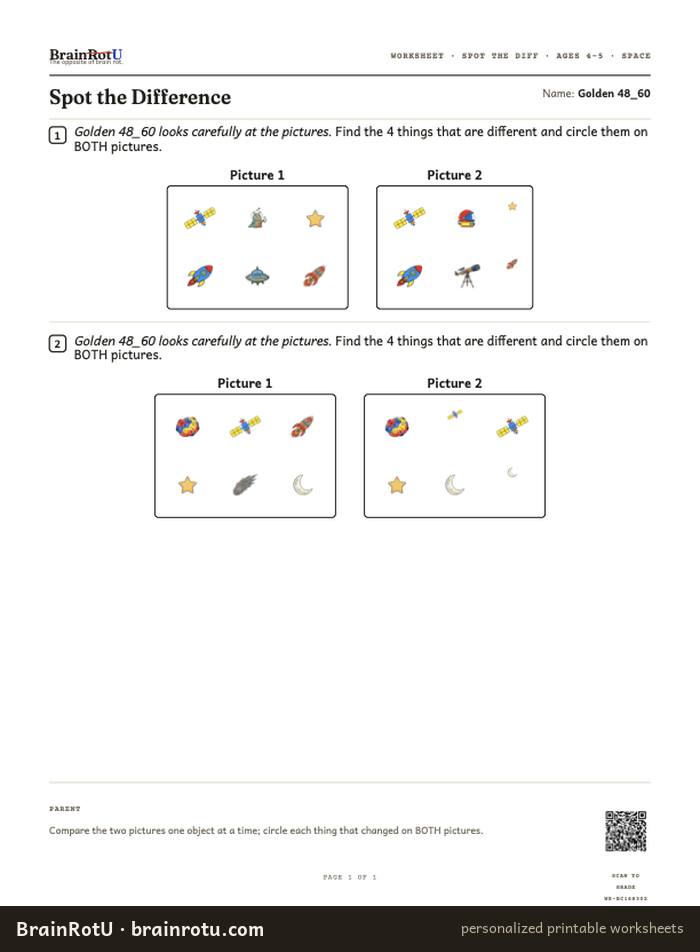
Spot the Difference
BrainRotU shows the child two almost-identical themed scenes and asks them to find what changed — a classic side-by-side comparison puzzle that builds careful observation, one-to-one comparison, and visual memory.
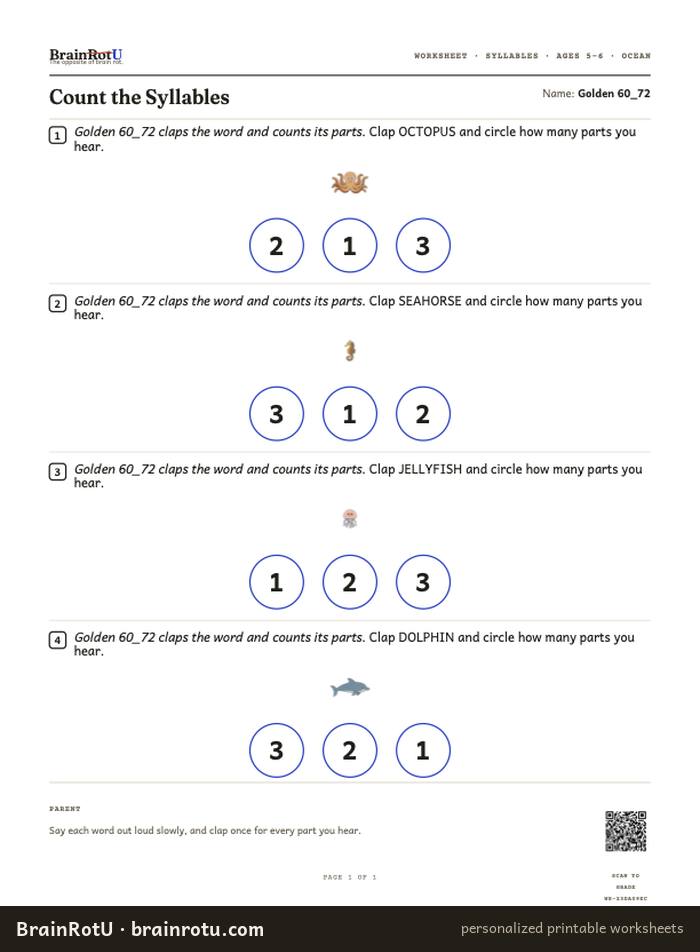
Count the Syllables
BrainRotU shows the child a themed picture and asks them to clap out the parts of its name and circle how many they hear — the syllable-segmentation skill that is a direct precursor to reading and spelling.
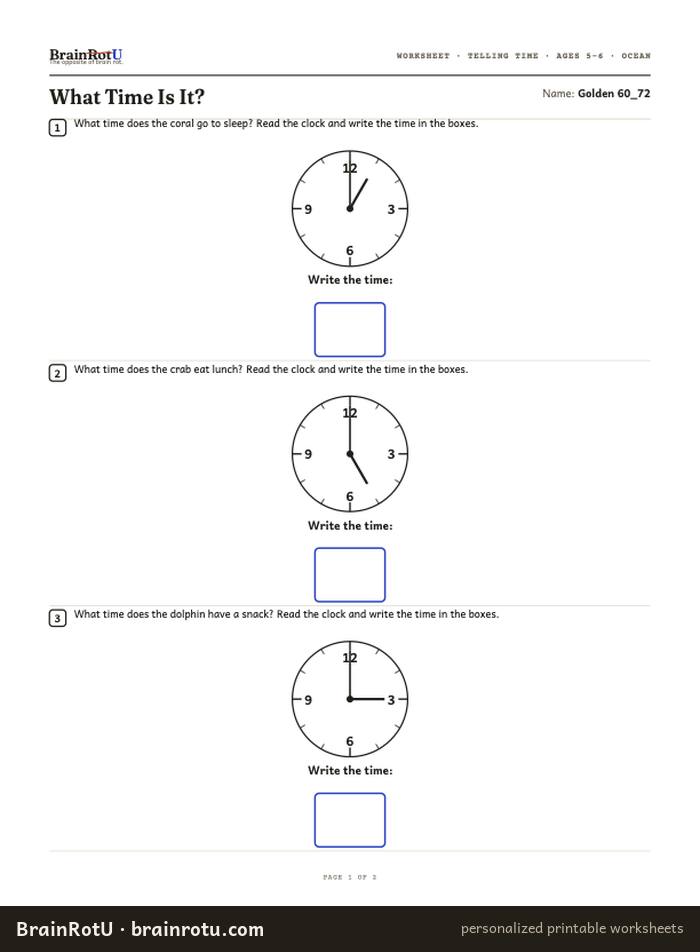
What Time Is It?
BrainRotU gives the child a printable of themed analog clocks to read — telling the child what time their favorite themed characters do each thing — building the Kindergarten-into-grade-1 skill of reading a clock to the hour and half-hour and writing the time.
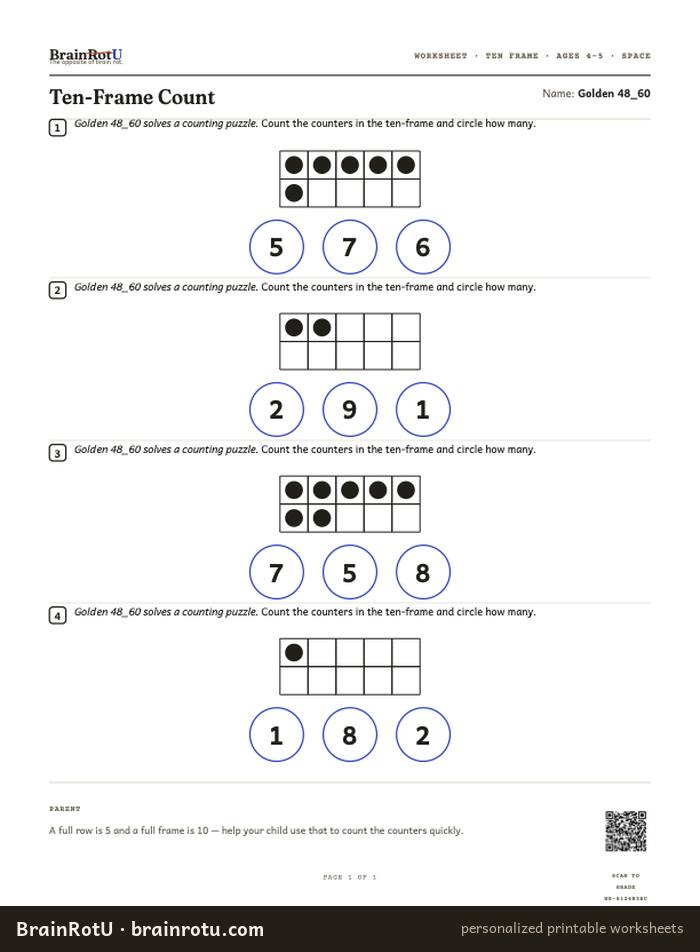
Ten-Frame Count
BrainRotU shows the child a ten-frame filled with themed counters and asks how many — the anchor-to-ten model every Kindergarten math curriculum uses to build number sense and, with two frames, teen-number place value.
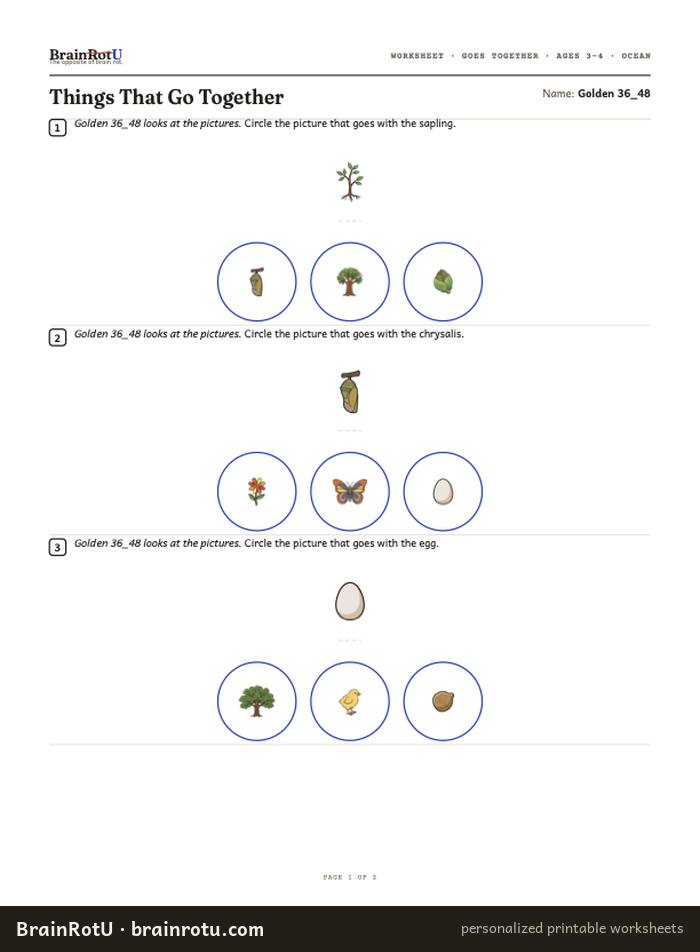
Things That Go Together
BrainRotU shows the child a picture and a row of choices and asks them to circle the one that goes with it — the caterpillar and its chrysalis, the seed and its flower — building the associative reasoning that underpins vocabulary, categories, and how the world fits together.
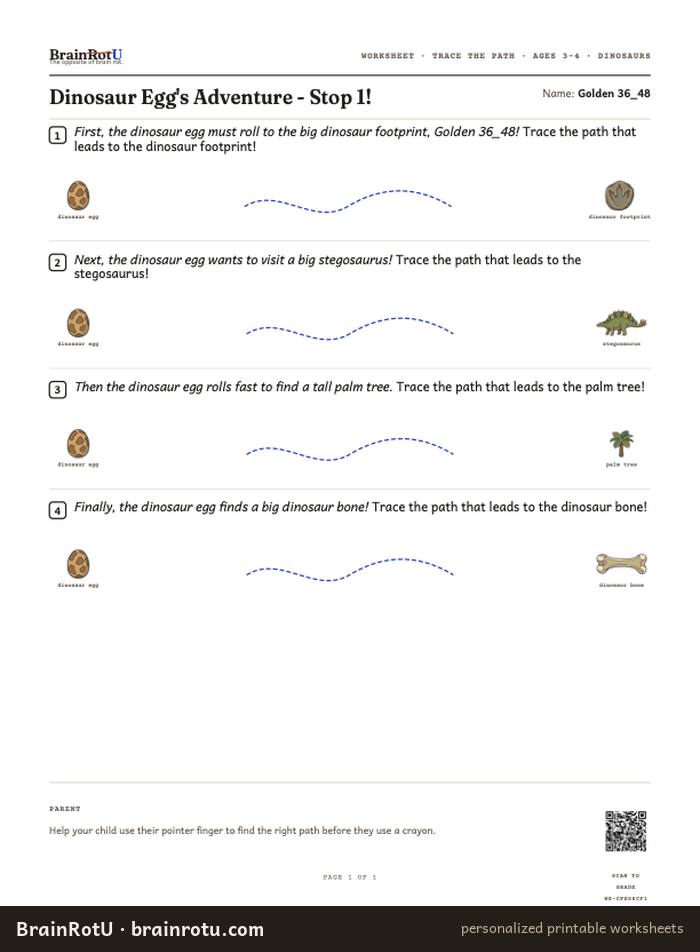
Trace the Path
BrainRotU gives the child a themed movement-based printable where they help a character reach a goal by tracing a path.
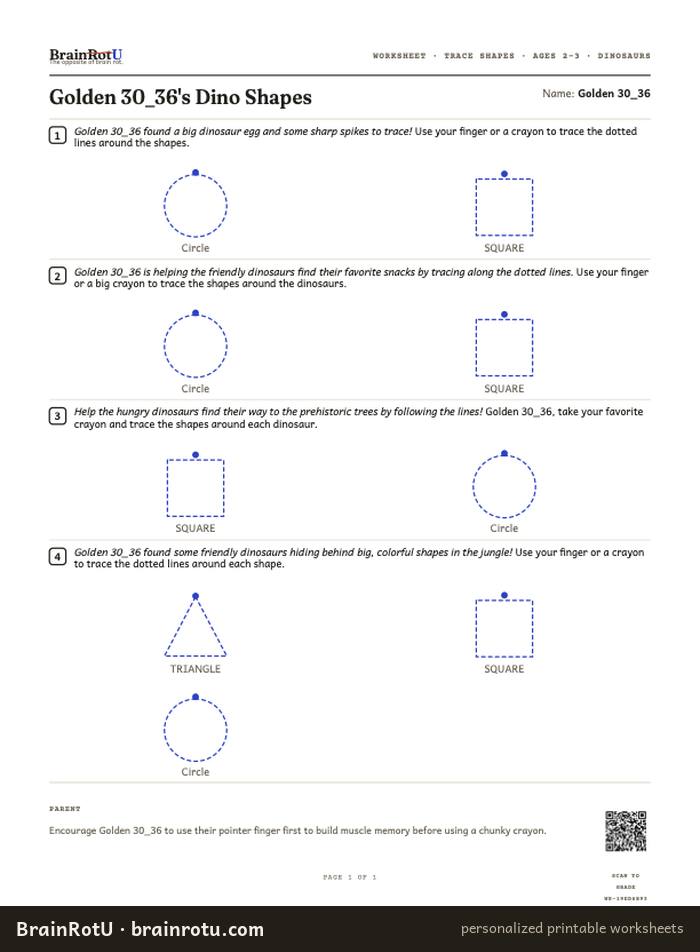
Trace the Shapes
BrainRotU gives the child a themed printable where they trace shape outlines, building the fine-motor control and shape recognition that precede letter and number formation.
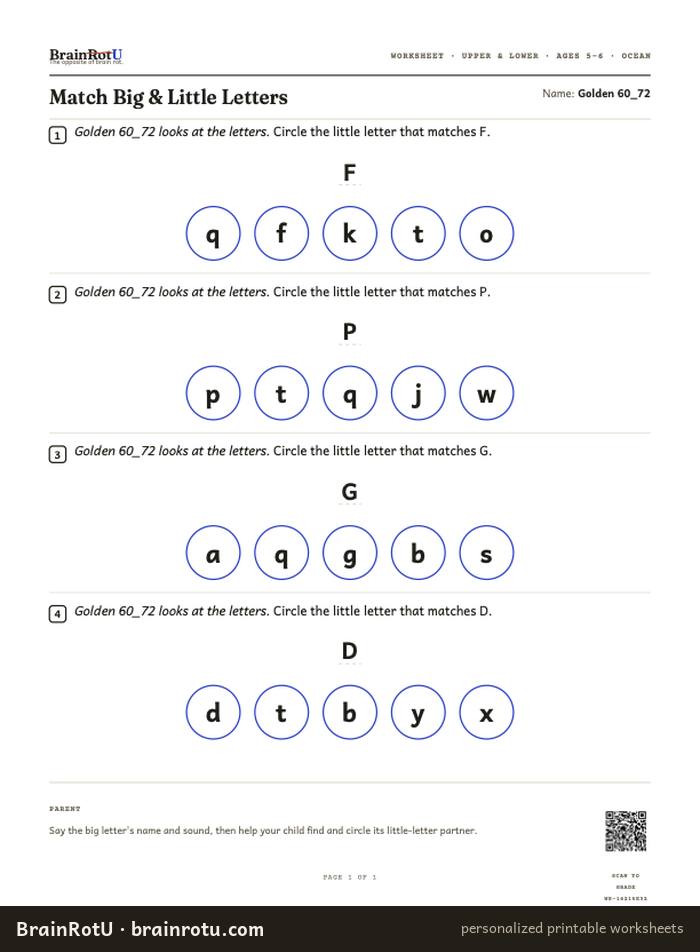
Match Big & Little Letters
BrainRotU gives the child a printable that pairs an uppercase letter with its lowercase partner among choices — building the big/little letter correspondence that underpins reading.
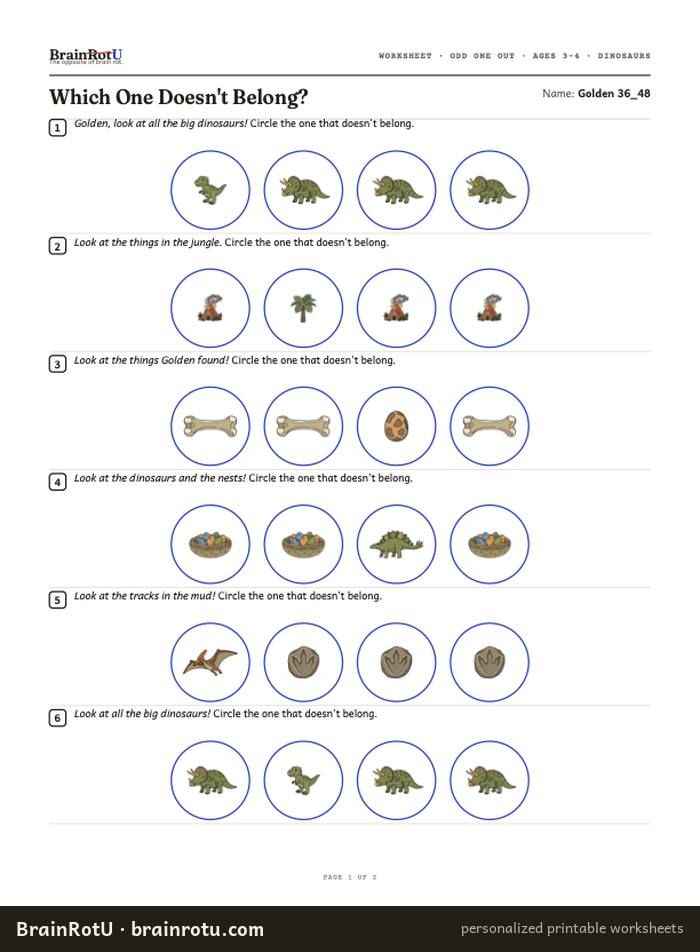
Which One Doesn't Belong?
BrainRotU gives the child a themed group of objects where one does not belong, building the categorize-and-exclude reasoning that underpins early classification.
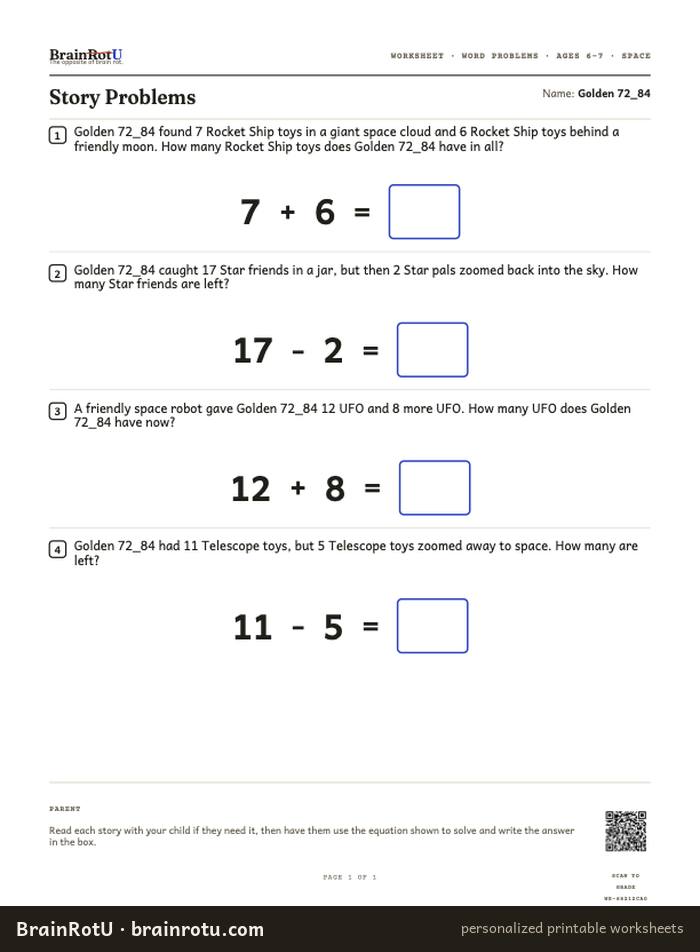
Story Problems
BrainRotU writes a playful, personalized story problem starring your child and their favorite theme — then asks them to solve it and write the answer. The numbers and the answer are fixed by BrainRotU so the math is always correct; only the story is themed (CCSS 1.OA word problems within 20).
Print this one, personalized for your kid
Tell us your child's age and what they love. We generate the worksheet tuned to them — you print it and sit down together with a pencil.
7 free prints at signup, no card · first month free when you subscribe · cancel anytime, effective at the end of your billing period.